An archivist who uncovered trade secrets from dusty records, weaving self-help on adaptive thinking, business lessons from ancient commerce, and detailed histories of global trade evolutions.
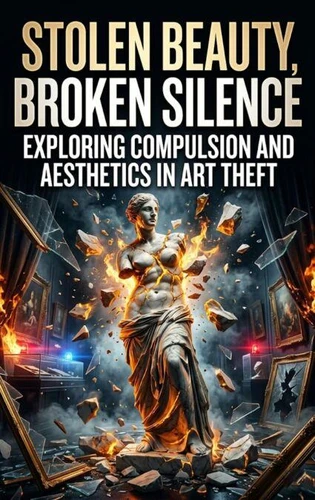
Stolen Beauty, Broken Silence. Exploring Compulsion and Aesthetics in Art Theft
Par :Formats :
Disponible dans votre compte client Decitre ou Furet du Nord dès validation de votre commande. Le format ePub est :
- Compatible avec une lecture sur My Vivlio (smartphone, tablette, ordinateur)
- Compatible avec une lecture sur liseuses Vivlio
- Pour les liseuses autres que Vivlio, vous devez utiliser le logiciel Adobe Digital Edition. Non compatible avec la lecture sur les liseuses Kindle, Remarkable et Sony
 , qui est-ce ?
Notre partenaire de plateforme de lecture numérique où vous retrouverez l'ensemble de vos ebooks gratuitement
Pour en savoir plus sur nos ebooks, consultez notre aide en ligne ici
C'est si simple ! Lisez votre ebook avec l'app Vivlio sur votre tablette, mobile ou ordinateur :

- Nombre de pages212
- FormatePub
- ISBN978-3-565-40735-4
- EAN9783565407354
- Date de parution13/04/2026
- Protection num.pas de protection
- Taille2 Mo
- Infos supplémentairesepub
- ÉditeurEmphaloz Publishing House
Résumé
There is something particular about the person who steals a painting. Unlike the bank robber or the jewel thief, the art thief operates in a domain where the object of desire cannot easily be converted into profit - where the stolen thing is, by the very nature of its fame, almost impossible to sell, display, or share. And yet they come, again and again, through skylights and service entrances, past laser grids and sleeping guards, drawn by something that defies straightforward criminal logic.
Art theft is among the most psychologically complex of crimes precisely because its motive is so rarely purely economic. It lives at the intersection of obsession, aesthetics, and the oldest human hunger: the desire to possess beauty absolutely. The history of art theft is simultaneously a history of the art world itself - its valuations, its vanities, its institutional blind spots, and the remarkable frequency with which museums, galleries, and private collectors have proven catastrophically vulnerable to determined human ingenuity.
The Isabella Stewart Gardner Museum heist of 1990 - thirteen works stolen in eighty-one minutes, including Vermeer's The Concert, never recovered - remains the largest property theft in history, a wound in the art world that has never closed. Nazi art looting during World War II displaced an estimated five million objects across Europe, many still missing, still contested, still surfacing in auction houses and private collections decades later.
Each case carries within it a story not merely of crime, but of cultural identity, institutional power, and the question of who truly owns a work of art.
Art theft is among the most psychologically complex of crimes precisely because its motive is so rarely purely economic. It lives at the intersection of obsession, aesthetics, and the oldest human hunger: the desire to possess beauty absolutely. The history of art theft is simultaneously a history of the art world itself - its valuations, its vanities, its institutional blind spots, and the remarkable frequency with which museums, galleries, and private collectors have proven catastrophically vulnerable to determined human ingenuity.
The Isabella Stewart Gardner Museum heist of 1990 - thirteen works stolen in eighty-one minutes, including Vermeer's The Concert, never recovered - remains the largest property theft in history, a wound in the art world that has never closed. Nazi art looting during World War II displaced an estimated five million objects across Europe, many still missing, still contested, still surfacing in auction houses and private collections decades later.
Each case carries within it a story not merely of crime, but of cultural identity, institutional power, and the question of who truly owns a work of art.