"My three-year-old could do that"
A man in a weekend jacket. A Rothko at the Stedelijk. Four seconds, a dismissal, and he moves on. He felt something the four seconds are the evidence but he had no road to it, so he reached for the only vocabulary available.
Lena watched him go. Then she went home and started writing.
She has been in every room. Van Eyck's workshop in Bruges in 1428, when oil paint first made it possible to hold light inside a surface.
Caravaggio's studio in Rome, where darkness was arranged so the light would mean something. Vermeer's north-facing room in Delft, where a camera obscura showed what light actually does as opposed to what painters had been trained to say it does. Géricault's studio in Paris, where severed limbs were delivered and studied and the raft was reconstructed plank by plank. A Zurich tavern in 1916, where Hugo Ball performed the sounds beneath language while Lenin prepared a revolution two doors down.
And Munich in July 1937, where six hundred and fifty paintings by Kirchner, Klee, Nolde, and Beckmann hung tilted and unframed under slogans, and two million people came to be shown what degenerate looked like.
Now she is a graduate student in Amsterdam, writing a thesis she is directing at the man who said the thing in front of the Rothko.
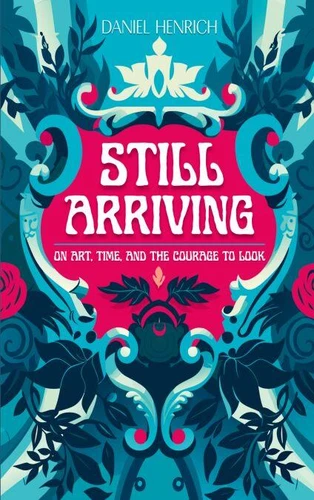
Still Arriving moves through six centuries, from the first white ground in a Flemish workshop to the dark maroon of a Rothko mural in a New York studio in 1958, where everything painting spent five hundred years accumulating has been stripped away, and what remains is the person standing in front of the canvas.
It is a novel in the form of a thesis, a thesis in the form of an open letter, and an open letter that turns out to be addressed to you.
Every painting in this novel is real. Every historical detail is accurate. The art history is not decoration, it is the architecture, built in sequence, chapter by chapter, so that by the time you arrive at a Rothko you understand exactly what it took six centuries to produce and why it matters that it exists.
No prior knowledge required. No lectures. Just the rooms, walked in order, and someone who has been in all of them willing to show you what she saw.
The road is here.
All you have to do is walk it.
"My three-year-old could do that"
A man in a weekend jacket. A Rothko at the Stedelijk. Four seconds, a dismissal, and he moves on. He felt something the four seconds are the evidence but he had no road to it, so he reached for the only vocabulary available.
Lena watched him go. Then she went home and started writing.
She has been in every room. Van Eyck's workshop in Bruges in 1428, when oil paint first made it possible to hold light inside a surface.
Caravaggio's studio in Rome, where darkness was arranged so the light would mean something. Vermeer's north-facing room in Delft, where a camera obscura showed what light actually does as opposed to what painters had been trained to say it does. Géricault's studio in Paris, where severed limbs were delivered and studied and the raft was reconstructed plank by plank. A Zurich tavern in 1916, where Hugo Ball performed the sounds beneath language while Lenin prepared a revolution two doors down.
And Munich in July 1937, where six hundred and fifty paintings by Kirchner, Klee, Nolde, and Beckmann hung tilted and unframed under slogans, and two million people came to be shown what degenerate looked like.
Now she is a graduate student in Amsterdam, writing a thesis she is directing at the man who said the thing in front of the Rothko.
Still Arriving moves through six centuries, from the first white ground in a Flemish workshop to the dark maroon of a Rothko mural in a New York studio in 1958, where everything painting spent five hundred years accumulating has been stripped away, and what remains is the person standing in front of the canvas.
It is a novel in the form of a thesis, a thesis in the form of an open letter, and an open letter that turns out to be addressed to you.
Every painting in this novel is real. Every historical detail is accurate. The art history is not decoration, it is the architecture, built in sequence, chapter by chapter, so that by the time you arrive at a Rothko you understand exactly what it took six centuries to produce and why it matters that it exists.
No prior knowledge required. No lectures. Just the rooms, walked in order, and someone who has been in all of them willing to show you what she saw.
The road is here.
All you have to do is walk it.