STEAM, SMOKE, AND SILENCE The Mosquito Fleet of West Puget SoundThe Sound keeps what it takes. That is the first thing you learn about Puget Sound if you grow up on its western shore - not the beauty of it, not the cold, not the mountains reflected in the gray water on the rare mornings when the clouds permit. The first thing you learn is that the Sound does not give things back. Not the boats it has claimed.
Not the men who went down with them. Not the names of those who were never on any official manifest to begin with. Historian Amaya Freeman knows this. She has known it since childhood, when her grandmother told stories about the Gulbranson family of Brownsville - stories that the county record didn't support, stories about a woman who kept her own accounts when no one else would, about a boy who went north for gold and came back changed, about a winter so silent the settlement stopped going to the docks.
Amaya is a professional. She files the stories under folklore and books a fellowship with the Kitsap Historical Society to write a rigorous, sourced, academically defensible history of the Mosquito Fleet - the coal-fired steamers that connected the isolated settlements of the West Sound to the markets of Seattle for eighty years, before the state absorbed them into the Washington State Ferry system in 1951 and the smoke cleared and the silence settled over the water for good.
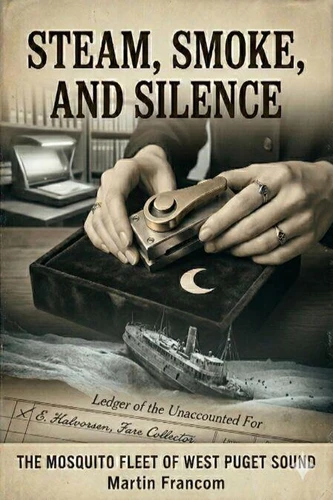
Then she opens a sealed archive box that has been sitting in the Society's basement since 1974, and she finds a ticket punch. Brass. Heavy. Its die cut in the shape of a crescent moon. Custom-ordered in 1905 by a man named E. Halvorsen, fare collector aboard the SS Dix - a top-heavy passenger steamer that went to the bottom of Elliott Bay on the night of November 18th, 1906, in five minutes, carrying thirty-nine people into six hundred feet of water off Alki Point.
The punch is dry. Uncorroded. Functional. It should be six hundred feet underwater. It is on her desk. What follows is two histories - the official one Amaya was commissioned to write, and the one she writes for herself. The second history moves through the fog-shrouded landings of the West Sound and through the lives of those the official ledger declined to record: Astrid Gulbranson, who named the Silent Winter and kept the accounts the county would not keep.
Captain George Barlow, who navigated the Sound by the position of the herons and the smell of the mud and the particular silence that preceded a bluff. Henrik Solberg, who read the Silverdale mudflats by color and instinct for twenty-two years before the corporation arrived with its printed tide tables and its offer he declined. Father Mikael Strand, who maintained a shadow registry of the souls the state had no reason to count.
And E. Halvorsen himself - present at two disasters, listed as lost in one, explained by neither - who moves through the margins of the fleet's history like a figure glimpsed in peripheral vision, his crescent moon marking the manifests of the uncounted. The Mosquito Fleet stopped for everyone. That was its founding promise and its social contract - written in coal smoke and cedar, maintained by captains who knew every landing by the sound of its water and every family by the shape of their dock.
No landing too remote. No load too small. No one left on the shore who was waving. Steam, Smoke, and Silence is the story of what happened when that promise was broken, and what happened when one woman - a century later, with a brass ticket punch and a notebook full of facts that didn't shift - decided to find out whose names had been left off the boats. A novel of the Pacific Northwest maritime frontier, braiding the voices of Norwegian settlers, Suquamish witnesses, independent pilots, and one modern historian who discovers that the most important archive is the one nobody knew was being kept.
STEAM, SMOKE, AND SILENCE The Mosquito Fleet of West Puget SoundThe Sound keeps what it takes. That is the first thing you learn about Puget Sound if you grow up on its western shore - not the beauty of it, not the cold, not the mountains reflected in the gray water on the rare mornings when the clouds permit. The first thing you learn is that the Sound does not give things back. Not the boats it has claimed.
Not the men who went down with them. Not the names of those who were never on any official manifest to begin with. Historian Amaya Freeman knows this. She has known it since childhood, when her grandmother told stories about the Gulbranson family of Brownsville - stories that the county record didn't support, stories about a woman who kept her own accounts when no one else would, about a boy who went north for gold and came back changed, about a winter so silent the settlement stopped going to the docks.
Amaya is a professional. She files the stories under folklore and books a fellowship with the Kitsap Historical Society to write a rigorous, sourced, academically defensible history of the Mosquito Fleet - the coal-fired steamers that connected the isolated settlements of the West Sound to the markets of Seattle for eighty years, before the state absorbed them into the Washington State Ferry system in 1951 and the smoke cleared and the silence settled over the water for good.
Then she opens a sealed archive box that has been sitting in the Society's basement since 1974, and she finds a ticket punch. Brass. Heavy. Its die cut in the shape of a crescent moon. Custom-ordered in 1905 by a man named E. Halvorsen, fare collector aboard the SS Dix - a top-heavy passenger steamer that went to the bottom of Elliott Bay on the night of November 18th, 1906, in five minutes, carrying thirty-nine people into six hundred feet of water off Alki Point.
The punch is dry. Uncorroded. Functional. It should be six hundred feet underwater. It is on her desk. What follows is two histories - the official one Amaya was commissioned to write, and the one she writes for herself. The second history moves through the fog-shrouded landings of the West Sound and through the lives of those the official ledger declined to record: Astrid Gulbranson, who named the Silent Winter and kept the accounts the county would not keep.
Captain George Barlow, who navigated the Sound by the position of the herons and the smell of the mud and the particular silence that preceded a bluff. Henrik Solberg, who read the Silverdale mudflats by color and instinct for twenty-two years before the corporation arrived with its printed tide tables and its offer he declined. Father Mikael Strand, who maintained a shadow registry of the souls the state had no reason to count.
And E. Halvorsen himself - present at two disasters, listed as lost in one, explained by neither - who moves through the margins of the fleet's history like a figure glimpsed in peripheral vision, his crescent moon marking the manifests of the uncounted. The Mosquito Fleet stopped for everyone. That was its founding promise and its social contract - written in coal smoke and cedar, maintained by captains who knew every landing by the sound of its water and every family by the shape of their dock.
No landing too remote. No load too small. No one left on the shore who was waving. Steam, Smoke, and Silence is the story of what happened when that promise was broken, and what happened when one woman - a century later, with a brass ticket punch and a notebook full of facts that didn't shift - decided to find out whose names had been left off the boats. A novel of the Pacific Northwest maritime frontier, braiding the voices of Norwegian settlers, Suquamish witnesses, independent pilots, and one modern historian who discovers that the most important archive is the one nobody knew was being kept.