Statistical Physics
Par :Formats :
Disponible dans votre compte client Decitre ou Furet du Nord dès validation de votre commande. Le format PDF est :
- Compatible avec une lecture sur My Vivlio (smartphone, tablette, ordinateur)
- Compatible avec une lecture sur liseuses Vivlio
- Pour les liseuses autres que Vivlio, vous devez utiliser le logiciel Adobe Digital Edition. Non compatible avec la lecture sur les liseuses Kindle, Remarkable et Sony
 , qui est-ce ?
Notre partenaire de plateforme de lecture numérique où vous retrouverez l'ensemble de vos ebooks gratuitement
Pour en savoir plus sur nos ebooks, consultez notre aide en ligne ici
C'est si simple ! Lisez votre ebook avec l'app Vivlio sur votre tablette, mobile ou ordinateur :

- Nombre de pages394
- FormatPDF
- ISBN978-3-8192-1892-7
- EAN9783819218927
- Date de parution14/05/2025
- Protection num.Digital Watermarking
- Taille3 Mo
- Infos supplémentairespdf
- ÉditeurBoD - Books on Demand
Résumé
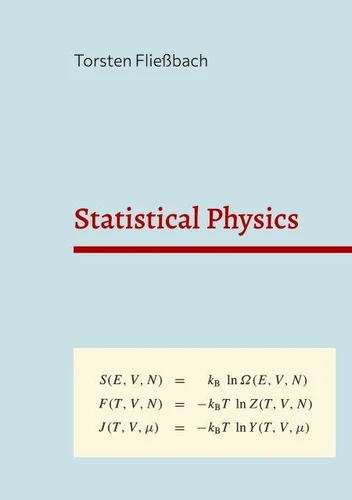
The central question of Statistical Physics is how macroscopic observables can be deduced from the microscopic structure. The answer is illuminated by the formulas on the front cover of the book: The partition functions on the right-hand sides (like Z) are defined microscopically. The left-hand sides display the respective macroscopic equilibrium observables (like the entropy S or the free energy F).
The first equation is the most famous one: In the form S = k log W it is depicted on Boltzmann's tombstone. Some major topics of the book are: -- Introduction to mathematical statistics including law of large numbers and central limit theorem. -- Fundamentals of Statistical Physics -- Thermodynamics and state variables -- Statistical ensembles -- Evaluation of a partition function for special systems: Spin systems, classical systems (real and ideal gases), quantum gases (He4, photons, phonons) -- Phase transitions, Landau theory and critical exponents -- Kinetic gas model: Transport coefficients
The first equation is the most famous one: In the form S = k log W it is depicted on Boltzmann's tombstone. Some major topics of the book are: -- Introduction to mathematical statistics including law of large numbers and central limit theorem. -- Fundamentals of Statistical Physics -- Thermodynamics and state variables -- Statistical ensembles -- Evaluation of a partition function for special systems: Spin systems, classical systems (real and ideal gases), quantum gases (He4, photons, phonons) -- Phase transitions, Landau theory and critical exponents -- Kinetic gas model: Transport coefficients