Nouveauté
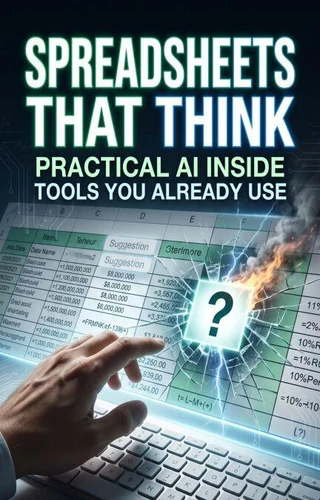
Spreadsheets That Think. Practical AI Inside Tools You Already Use
Par :Formats :
Disponible dans votre compte client Decitre ou Furet du Nord dès validation de votre commande. Le format ePub est :
- Compatible avec une lecture sur My Vivlio (smartphone, tablette, ordinateur)
- Compatible avec une lecture sur liseuses Vivlio
- Pour les liseuses autres que Vivlio, vous devez utiliser le logiciel Adobe Digital Edition. Non compatible avec la lecture sur les liseuses Kindle, Remarkable et Sony
 , qui est-ce ?
Notre partenaire de plateforme de lecture numérique où vous retrouverez l'ensemble de vos ebooks gratuitement
Pour en savoir plus sur nos ebooks, consultez notre aide en ligne ici
C'est si simple ! Lisez votre ebook avec l'app Vivlio sur votre tablette, mobile ou ordinateur :

- Nombre de pages135
- FormatePub
- ISBN978-3-565-56527-6
- EAN9783565565276
- Date de parution16/07/2026
- Protection num.pas de protection
- Taille664 Ko
- Infos supplémentairesepub
- ÉditeurEmphaloz Publishing House
Résumé
The software on your computer is no longer waiting for your command. In tools like Excel and Gmail, a quiet revolution has taken place: the software has started to think, guessing your intent to boost productivity. But this newfound convenience comes with a hidden cost.
Spreadsheets That Think reveals the profound consequences of this shift. Drawing on landmark studies from Harvard, MIT, and the Boston Consulting Group, it shows how AI assistance can paradoxically stifle innovation, leading to a 41% drop in idea diversity among even elite consultants.
The book unpacks the psychology of automation bias and cognitive offloading, explaining how reliance on predictive tools can homogenize thinking and degrade professional expertise. This is not a manual for rejecting technology, but a guide to mastering it. It provides the critical frameworks needed to collaborate with AI, verify its output, and retain the most valuable asset in the modern workplace: independent judgment.
Discover how to leverage the power of thinking software without sacrificing the ingenuity that makes you human.
The book unpacks the psychology of automation bias and cognitive offloading, explaining how reliance on predictive tools can homogenize thinking and degrade professional expertise. This is not a manual for rejecting technology, but a guide to mastering it. It provides the critical frameworks needed to collaborate with AI, verify its output, and retain the most valuable asset in the modern workplace: independent judgment.
Discover how to leverage the power of thinking software without sacrificing the ingenuity that makes you human.