
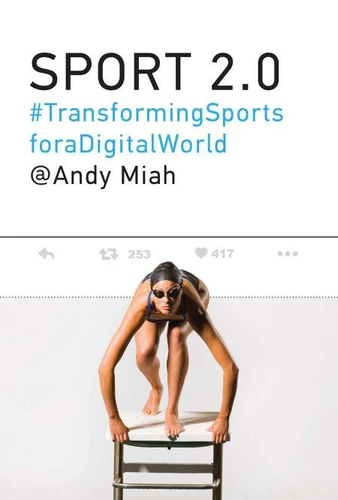
Sport 2.0. Transforming Sports for a Digital World
Par :Formats :
Disponible dans votre compte client Decitre ou Furet du Nord dès validation de votre commande. Le format ePub protégé est :
- Compatible avec une lecture sur My Vivlio (smartphone, tablette, ordinateur)
- Compatible avec une lecture sur liseuses Vivlio
- Pour les liseuses autres que Vivlio, vous devez utiliser le logiciel Adobe Digital Edition. Non compatible avec la lecture sur les liseuses Kindle, Remarkable et Sony
- Non compatible avec un achat hors France métropolitaine
 , qui est-ce ?
Notre partenaire de plateforme de lecture numérique où vous retrouverez l'ensemble de vos ebooks gratuitement
Pour en savoir plus sur nos ebooks, consultez notre aide en ligne ici
C'est si simple ! Lisez votre ebook avec l'app Vivlio sur votre tablette, mobile ou ordinateur :

- Nombre de pages288
- FormatePub
- ISBN978-0-262-34312-1
- EAN9780262343121
- Date de parution17/02/2017
- Protection num.Adobe DRM
- Taille1 Mo
- Infos supplémentairesepub
- ÉditeurThe MIT Press
Résumé
Ramifications of the convergence of sports and digital technology, from athlete and spectator experience to the role of media innovation at the Olympics. Digital technology is changing everything about modern sports. Athletes and coaches rely on digital data to monitor and enhance performance. Officials use tracking systems to augment their judgment in what is an increasingly superhuman field of play.
Spectators tune in to live sports through social media, or even through virtual reality. Audiences now act as citizen journalists whose collective shared data expands the places in which we consume sports news. In Sport 2.0, Andy Miah examines the convergence of sports and digital cultures, examining not only how it affects our participation in sport but also how it changes our experience of life online.
This convergence redefines how we think of about our bodies, the social function of sports, and the kinds of people who are playing. Miah describes a world in which the rise of competitive computer game playing-e-sports-challenges and invigorates the social mandate. Miah also looks at the Olympic Games as an exemplar of digital innovation in sports, and offers a detailed look at the social media footprint of the 2012 London Games, discussing how organizers, sponsors, media, and activists responded to the world's largest media event.
In the end, Miah does not argue that physical activity will cease to be central to sports, or that digital corporeality will replace the nondigital version. Rather, he provides a road map for how sports will become mixed-reality experiences and abandon the duality of physical and digital.
Spectators tune in to live sports through social media, or even through virtual reality. Audiences now act as citizen journalists whose collective shared data expands the places in which we consume sports news. In Sport 2.0, Andy Miah examines the convergence of sports and digital cultures, examining not only how it affects our participation in sport but also how it changes our experience of life online.
This convergence redefines how we think of about our bodies, the social function of sports, and the kinds of people who are playing. Miah describes a world in which the rise of competitive computer game playing-e-sports-challenges and invigorates the social mandate. Miah also looks at the Olympic Games as an exemplar of digital innovation in sports, and offers a detailed look at the social media footprint of the 2012 London Games, discussing how organizers, sponsors, media, and activists responded to the world's largest media event.
In the end, Miah does not argue that physical activity will cease to be central to sports, or that digital corporeality will replace the nondigital version. Rather, he provides a road map for how sports will become mixed-reality experiences and abandon the duality of physical and digital.