
Author
Nouveauté
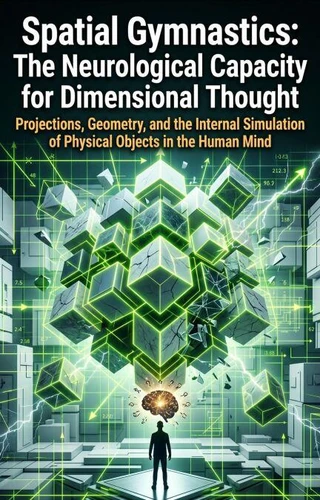
Spatial Gymnastics: The Neurological Capacity for Dimensional Thought. Projections, Geometry, and the Internal Simulation of Physical Objects in the Human Mind
Par :Formats :
Disponible dans votre compte client Decitre ou Furet du Nord dès validation de votre commande. Le format ePub est :
- Compatible avec une lecture sur My Vivlio (smartphone, tablette, ordinateur)
- Compatible avec une lecture sur liseuses Vivlio
- Pour les liseuses autres que Vivlio, vous devez utiliser le logiciel Adobe Digital Edition. Non compatible avec la lecture sur les liseuses Kindle, Remarkable et Sony
 , qui est-ce ?
Notre partenaire de plateforme de lecture numérique où vous retrouverez l'ensemble de vos ebooks gratuitement
Pour en savoir plus sur nos ebooks, consultez notre aide en ligne ici
C'est si simple ! Lisez votre ebook avec l'app Vivlio sur votre tablette, mobile ou ordinateur :

- Nombre de pages173
- FormatePub
- ISBN978-3-565-55447-8
- EAN9783565554478
- Date de parution10/07/2026
- Protection num.pas de protection
- Taille808 Ko
- Infos supplémentairesepub
- ÉditeurEmphaloz Publishing House
Résumé
The ability to visualize an object, mentally turn it upside down, and accurately predict its new appearance is a silent neurological miracle. This process, known as mental rotation, is a fundamental pillar of human spatial intelligence, yet the biological mechanism behind it remains intensely demanding on the brain.
When a person attempts to rotate a complex geometric shape in their mind, the parietal lobe does not simply calculate an algorithm.
Instead, the brain simulates the actual physical movement of the object in real-time. The further an object must be mentally rotated, the longer it takes the subject to answer questions about its structure. This linear correlation between imagined movement and physical time proves that human cognition is bound by the laws of real-world physics, even inside the imagination. Furthermore, proficiency in this spatial gymnastics varies wildly among individuals, directly predicting aptitude in fields ranging from surgical medicine to structural engineering. Exploring the limits of visual working memory, this text maps the neurological pathways of internal simulation.
It explains how our minds construct, hold, and manipulate three-dimensional realities using nothing but electrical impulses.
Instead, the brain simulates the actual physical movement of the object in real-time. The further an object must be mentally rotated, the longer it takes the subject to answer questions about its structure. This linear correlation between imagined movement and physical time proves that human cognition is bound by the laws of real-world physics, even inside the imagination. Furthermore, proficiency in this spatial gymnastics varies wildly among individuals, directly predicting aptitude in fields ranging from surgical medicine to structural engineering. Exploring the limits of visual working memory, this text maps the neurological pathways of internal simulation.
It explains how our minds construct, hold, and manipulate three-dimensional realities using nothing but electrical impulses.