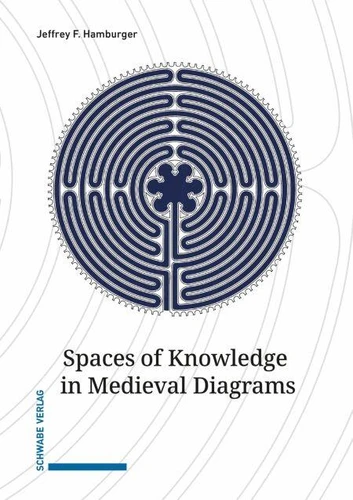
Spaces of Knowledge in Medieval Diagrams
Par :Formats :
Disponible dans votre compte client Decitre ou Furet du Nord dès validation de votre commande. Le format PDF est :
- Compatible avec une lecture sur My Vivlio (smartphone, tablette, ordinateur)
- Compatible avec une lecture sur liseuses Vivlio
- Pour les liseuses autres que Vivlio, vous devez utiliser le logiciel Adobe Digital Edition. Non compatible avec la lecture sur les liseuses Kindle, Remarkable et Sony
 , qui est-ce ?
Notre partenaire de plateforme de lecture numérique où vous retrouverez l'ensemble de vos ebooks gratuitement
Pour en savoir plus sur nos ebooks, consultez notre aide en ligne ici
C'est si simple ! Lisez votre ebook avec l'app Vivlio sur votre tablette, mobile ou ordinateur :

- Nombre de pages68
- FormatPDF
- ISBN978-3-7965-5412-4
- EAN9783796554124
- Date de parution08/12/2025
- Protection num.Digital Watermarking
- Taille15 Mo
- Infos supplémentairespdf
- ÉditeurSchwabe & Co
Résumé
The spatial structure of diagrams can be described in algebraic, geometric, cognitive or semiotic terms. Based on the ?Ur-diagram' of the Divided Line in Plato's ?Republic', diagrams can be understood as representations of the visible and the intelligible world. However, the knowledge thus conveyed is subject to the contingency of material and contextual, i.e., period-specific circumstances. How is the spatial organization of diagrams in medieval manuscripts structured under such conditions? The examples dealt with in this essay range from diagrammaric glosses to the late antique ?Corpus Dionysiacum' to visualizations of the powers of perception and cognition by the Renaissance scholar Charles Bovelles.
Medieval spaces of knowledge encompassed not only the confines of libraries or the extended social networks within which books were written, exchanged, and read; they also took shape on the page, most persuasively in the form of diagrams.
Medieval spaces of knowledge encompassed not only the confines of libraries or the extended social networks within which books were written, exchanged, and read; they also took shape on the page, most persuasively in the form of diagrams.