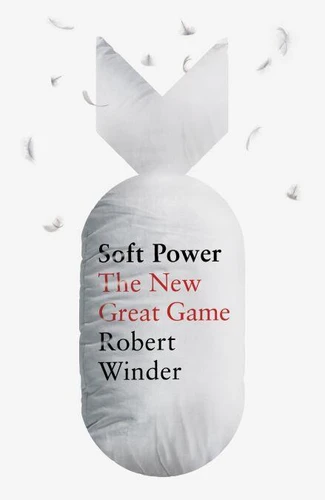
In recent years the modern world has developed a brave new concept: 'soft power'. It is the power of friendly persuasion rather than command, and it invites nations to compete (as they did in the nineteenth century) to expand their 'sphere of influence' as brands in a global marketplace. In Bloody Foreigners and The Last Wolf, Robert Winder explored the way Britain was shaped first by migration, and then by hidden geographical factors.
Now, in Soft Power he reveals the ways in which modern states are asserting themselves not through traditional realpolitik but through alternative means: business, language, culture, ideas, sport, education, music, even food - the texture and values of history and daily life. Moving from West to East, the book tells the story of soft power by exploring the varied ways in which it operates - from an American sheriff in Poland to an English garden in Ravello, a French vineyard in Australia, an Asian restaurant in Spain, a Chinese Friendship Hall in Sudan; the fact that fifty-eight modern heads of state were educated in Britain; the student exchange that took a teenage Deng Xiaoping to a small town on the Loire; the way that Japan could seduce the world with chic food and smart computer games.
Now there may be a new twist in this Great game. With soft power's quiet ingredients - education, science, trade, cultural values - and a new emphasis on shared mutual interest, it may be the only force supple enough to tackle the challenges the future looks likely to pose - not least the slam-the-door reflexes pulling in the other direction.
In recent years the modern world has developed a brave new concept: 'soft power'. It is the power of friendly persuasion rather than command, and it invites nations to compete (as they did in the nineteenth century) to expand their 'sphere of influence' as brands in a global marketplace. In Bloody Foreigners and The Last Wolf, Robert Winder explored the way Britain was shaped first by migration, and then by hidden geographical factors.
Now, in Soft Power he reveals the ways in which modern states are asserting themselves not through traditional realpolitik but through alternative means: business, language, culture, ideas, sport, education, music, even food - the texture and values of history and daily life. Moving from West to East, the book tells the story of soft power by exploring the varied ways in which it operates - from an American sheriff in Poland to an English garden in Ravello, a French vineyard in Australia, an Asian restaurant in Spain, a Chinese Friendship Hall in Sudan; the fact that fifty-eight modern heads of state were educated in Britain; the student exchange that took a teenage Deng Xiaoping to a small town on the Loire; the way that Japan could seduce the world with chic food and smart computer games.
Now there may be a new twist in this Great game. With soft power's quiet ingredients - education, science, trade, cultural values - and a new emphasis on shared mutual interest, it may be the only force supple enough to tackle the challenges the future looks likely to pose - not least the slam-the-door reflexes pulling in the other direction.

 , qui est-ce ?