
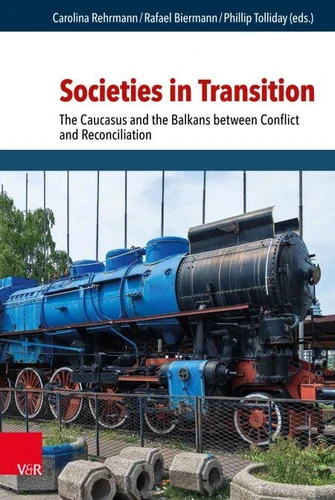
Societies in Transition. The Caucasus and the Balkans between Conflict and Reconciliation
Par : , , , ,Formats :
Disponible dans votre compte client Decitre ou Furet du Nord dès validation de votre commande. Le format PDF est :
- Compatible avec une lecture sur My Vivlio (smartphone, tablette, ordinateur)
- Compatible avec une lecture sur liseuses Vivlio
- Pour les liseuses autres que Vivlio, vous devez utiliser le logiciel Adobe Digital Edition. Non compatible avec la lecture sur les liseuses Kindle, Remarkable et Sony
 , qui est-ce ?
Notre partenaire de plateforme de lecture numérique où vous retrouverez l'ensemble de vos ebooks gratuitement
Pour en savoir plus sur nos ebooks, consultez notre aide en ligne ici
C'est si simple ! Lisez votre ebook avec l'app Vivlio sur votre tablette, mobile ou ordinateur :

- Nombre de pages351
- FormatPDF
- ISBN978-3-647-52206-7
- EAN9783647522067
- Date de parution20/01/2020
- Protection num.pas de protection
- Taille4 Mo
- Infos supplémentairespdf
- ÉditeurVandenhoeck & Ruprecht
Résumé
Since the end of the Cold War, the collapse of the Soviet Union and the dissolution of Yugoslavia, the Mediterranean and Black Sea regions have been faced with multiple upheavals of interethnic violence, bloody secessions and ethnic cleansing. Up to the present, both regions are confronted with unresolved border, minority and security issues, matters of recognition, protracted traumata and claims for justice.
After the fall of the iron curtain, simmering ethnic tensions turned into hot wars that created new states, new power-political hierarchies and a heritage of violence. Reaching back to the early 1990s, several international and national transitional justice measures have been applied to face these heritages and lay the foundations for a common future. For the former Yugoslavia, they range from broad criminal trials to a series of restorative justice mechanisms; in the North and South Caucasus they encompass numerous mediation measures and primarily restorative justice efforts. The present volume is concerned with strategies of conflict resolution and prevention subsumed under the concept of reconciliation.
It aims at understanding the socio-emotional root causes of political cleavages and daily realities of (post-) conflict societies, especially regarding the impact of competing narratives and unprocessed pasts on exclusive identities and strategic political choices. Applying reconciliation theory, insights from collective memory and transitional justice to a series of selected field studies, it sheds light on the origins of interethnic violence, aims at finding explanations for the fact that many of the above-mentioned conflicts have become intractable and discusses the chances and challenges for transforming interests, emotions, perspectives, roles and identities between and within the respective societies.
After the fall of the iron curtain, simmering ethnic tensions turned into hot wars that created new states, new power-political hierarchies and a heritage of violence. Reaching back to the early 1990s, several international and national transitional justice measures have been applied to face these heritages and lay the foundations for a common future. For the former Yugoslavia, they range from broad criminal trials to a series of restorative justice mechanisms; in the North and South Caucasus they encompass numerous mediation measures and primarily restorative justice efforts. The present volume is concerned with strategies of conflict resolution and prevention subsumed under the concept of reconciliation.
It aims at understanding the socio-emotional root causes of political cleavages and daily realities of (post-) conflict societies, especially regarding the impact of competing narratives and unprocessed pasts on exclusive identities and strategic political choices. Applying reconciliation theory, insights from collective memory and transitional justice to a series of selected field studies, it sheds light on the origins of interethnic violence, aims at finding explanations for the fact that many of the above-mentioned conflicts have become intractable and discusses the chances and challenges for transforming interests, emotions, perspectives, roles and identities between and within the respective societies.