
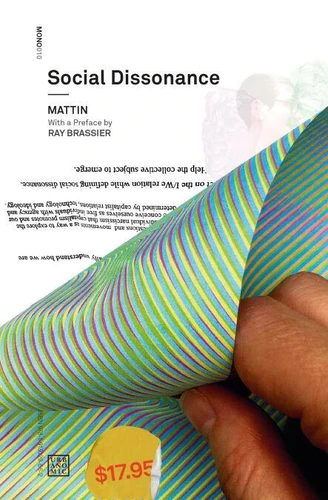
Social Dissonance
Par :Formats :
Disponible dans votre compte client Decitre ou Furet du Nord dès validation de votre commande. Le format ePub protégé est :
- Compatible avec une lecture sur My Vivlio (smartphone, tablette, ordinateur)
- Compatible avec une lecture sur liseuses Vivlio
- Pour les liseuses autres que Vivlio, vous devez utiliser le logiciel Adobe Digital Edition. Non compatible avec la lecture sur les liseuses Kindle, Remarkable et Sony
- Non compatible avec un achat hors France métropolitaine
 , qui est-ce ?
Notre partenaire de plateforme de lecture numérique où vous retrouverez l'ensemble de vos ebooks gratuitement
Pour en savoir plus sur nos ebooks, consultez notre aide en ligne ici
C'est si simple ! Lisez votre ebook avec l'app Vivlio sur votre tablette, mobile ou ordinateur :

- Nombre de pages256
- FormatePub
- ISBN978-1-913029-86-9
- EAN9781913029869
- Date de parution31/05/2022
- Protection num.Adobe DRM
- Taille2 Mo
- Infos supplémentairesepub
- ÉditeurUrbanomic
Résumé
An argument that by amplifying alienation in performance, we can shift the emphasis from the sonic to the social. Work in sound studies continues to seek out sound "itself"--but, today, when the aesthetic can claim no autonomy and the agency of both artist and audience is socially constituted, why not explore the social mediation already present within our experience of the sonorous? In this work, artist, musician, performer, and theorist Mattin sets out an understanding of alienation as a constitutive part of subjectivity and as an enabling condition for exploring social dissonance--the discrepancy between our individual narcissism and our social capacity.
Mattin's theoretical investigation is intertwined with documentation of a concrete experiment in the form of an instructional score (performed at documenta 14, 2017, in Athens and Kassel) which explores these conceptual connotations in practice, as players use members of the audience as instruments, who then hear themselves and reflect on their own conception and self-presentation. Social Dissonance claims that, by amplifying alienation in performance and participation in order to understand how we are constructed through various forms of mediation, we can shift the emphasis from the sonic to the social, and in doing so, discover for ourselves that social dissonance is the territory within which we already find ourselves, the condition we inhabit.
Mattin's theoretical investigation is intertwined with documentation of a concrete experiment in the form of an instructional score (performed at documenta 14, 2017, in Athens and Kassel) which explores these conceptual connotations in practice, as players use members of the audience as instruments, who then hear themselves and reflect on their own conception and self-presentation. Social Dissonance claims that, by amplifying alienation in performance and participation in order to understand how we are constructed through various forms of mediation, we can shift the emphasis from the sonic to the social, and in doing so, discover for ourselves that social dissonance is the territory within which we already find ourselves, the condition we inhabit.