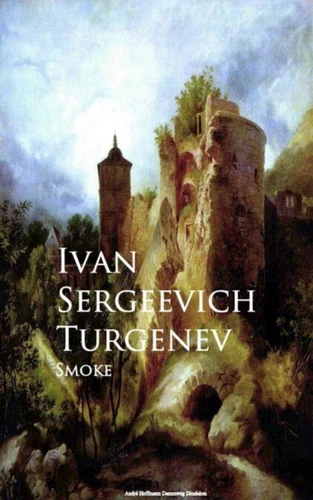
Smoke
Par :Formats :
Disponible dans votre compte client Decitre ou Furet du Nord dès validation de votre commande. Le format ePub est :
- Compatible avec une lecture sur My Vivlio (smartphone, tablette, ordinateur)
- Compatible avec une lecture sur liseuses Vivlio
- Pour les liseuses autres que Vivlio, vous devez utiliser le logiciel Adobe Digital Edition. Non compatible avec la lecture sur les liseuses Kindle, Remarkable et Sony
 , qui est-ce ?
Notre partenaire de plateforme de lecture numérique où vous retrouverez l'ensemble de vos ebooks gratuitement
Pour en savoir plus sur nos ebooks, consultez notre aide en ligne ici
C'est si simple ! Lisez votre ebook avec l'app Vivlio sur votre tablette, mobile ou ordinateur :

- Nombre de pages380
- FormatePub
- ISBN978-3-7364-1423-5
- EAN9783736414235
- Date de parution06/09/2016
- Protection num.Digital Watermarking
- Taille522 Ko
- Infos supplémentairesepub
- ÉditeurAndhof
Résumé
'Smoke' was first published in 1867, several years after Turgenev had fixed his home in Baden, with his friends the Viardots. Baden at this date was a favourite resort for all circles of Russian society, and Turgenev was able to study at his leisure his countrymen as they appeared to foreign critical eyes. The novel is therefore the most cosmopolitan of all Turgenev's works. On a veiled background of the great world of European society, little groups of representative Russians, members of the aristocratic and the Young Russia parties, are etched with an incisive, unfaltering hand.
Smoke, as an historical study, though it yields in importance to Fathers and Children and Virgin Soil, is of great significance to Russians. It might with truth have been named Transition, for the generation it paints was then midway between the early philosophical Nihilism-vi- of the sixties and the active political Nihilism of the seventies. Markedly transitional, however, as was the Russian mind of the days of Smoke, Turgenev, with the faculty that distinguishes the great artist from the artist of second rank, the faculty of seeking out and stamping the essential under confused and fleeting forms, has once and for ever laid bare the fundamental weakness of the Slav nature, its weakness of will.
Smoke is an attack, a deserved attack, not merely on the Young Russia Party, but on all the Parties; not on the old ideas or the new ideas, but on the proneness of the Slav nature to fall a prey to a consuming weakness, a moral stagnation, a feverish ennui, the Slav nature that analyses everything with force and brilliancy, and ends, so often, by doing nothing. Smoke is the attack, bitter yet sympathetic, of a man who, with growing despair, has watched the weakness of his countrymen, while he loves his country all the more for the bitterness their sins have brought upon it.
Smoke, as an historical study, though it yields in importance to Fathers and Children and Virgin Soil, is of great significance to Russians. It might with truth have been named Transition, for the generation it paints was then midway between the early philosophical Nihilism-vi- of the sixties and the active political Nihilism of the seventies. Markedly transitional, however, as was the Russian mind of the days of Smoke, Turgenev, with the faculty that distinguishes the great artist from the artist of second rank, the faculty of seeking out and stamping the essential under confused and fleeting forms, has once and for ever laid bare the fundamental weakness of the Slav nature, its weakness of will.
Smoke is an attack, a deserved attack, not merely on the Young Russia Party, but on all the Parties; not on the old ideas or the new ideas, but on the proneness of the Slav nature to fall a prey to a consuming weakness, a moral stagnation, a feverish ennui, the Slav nature that analyses everything with force and brilliancy, and ends, so often, by doing nothing. Smoke is the attack, bitter yet sympathetic, of a man who, with growing despair, has watched the weakness of his countrymen, while he loves his country all the more for the bitterness their sins have brought upon it.
A propos de Ivan Sergeevich Turgenev
Pasinkow
E-book
0,99 €
0,99 €

0,99 €
0,99 €
0,49 €
A House of Gentlefolk
E-book
0,49 €
Fathers and Sons
E-book
0,49 €
0,99 €
0,99 €