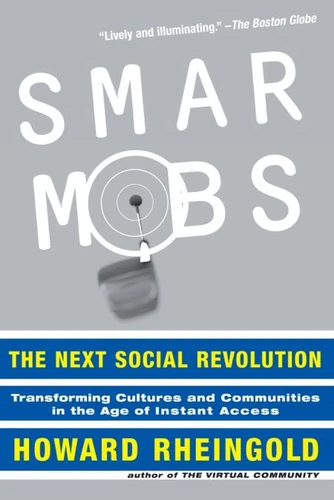
From Tokyo to Helsinki, Manhattan to Manila, Howard Rheingold takes us on a journey around the world for a preview of the next techno-cultural shift-a shift he predicts will be as dramatic as the widespread adoption of the PC in the 1980s and the Internet in the 1990s. The coming wave, says Rheingold, is the result of super-efficient mobile communications-cellular phones, personal digital assistants, and wireless-paging and Internet-access devices that will allow us to connect with anyone, anywhere, anytime.
From the amusing ("Lovegetty" devices in Japan that light up when a person with the right date-potential characteristics appears in the vicinity) to the extraordinary (the overthrow of a repressive regime in the Philippines by political activists who mobilized by forwarding text messages via cell phones), Rheingold gives examples of the fundamentally new ways in which people are already engaging in group or collective action.
He also considers the dark side of this phenomenon, such as the coordination of terrorist cells, threats to privacy, and the ability to incite violent behavior. Applying insights from sociology, artificial intelligence, engineering, and anthropology, Rheingold offers a penetrating perspective on the brave new convergence of pop culture, cutting-edge technology, and social activism. At the same time, he reminds us that, as with other technological revolutions, the real impact of mobile communications will come not from the technology itself but from how people use it, resist it, adapt to it, and ultimately use it to transform themselves, their communities, and their institutions.
From Tokyo to Helsinki, Manhattan to Manila, Howard Rheingold takes us on a journey around the world for a preview of the next techno-cultural shift-a shift he predicts will be as dramatic as the widespread adoption of the PC in the 1980s and the Internet in the 1990s. The coming wave, says Rheingold, is the result of super-efficient mobile communications-cellular phones, personal digital assistants, and wireless-paging and Internet-access devices that will allow us to connect with anyone, anywhere, anytime.
From the amusing ("Lovegetty" devices in Japan that light up when a person with the right date-potential characteristics appears in the vicinity) to the extraordinary (the overthrow of a repressive regime in the Philippines by political activists who mobilized by forwarding text messages via cell phones), Rheingold gives examples of the fundamentally new ways in which people are already engaging in group or collective action.
He also considers the dark side of this phenomenon, such as the coordination of terrorist cells, threats to privacy, and the ability to incite violent behavior. Applying insights from sociology, artificial intelligence, engineering, and anthropology, Rheingold offers a penetrating perspective on the brave new convergence of pop culture, cutting-edge technology, and social activism. At the same time, he reminds us that, as with other technological revolutions, the real impact of mobile communications will come not from the technology itself but from how people use it, resist it, adapt to it, and ultimately use it to transform themselves, their communities, and their institutions.

 , qui est-ce ?
