
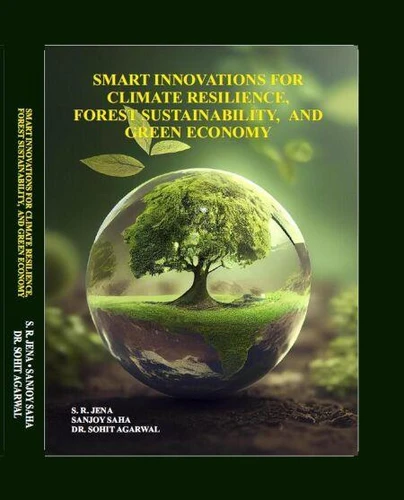
Smart Innovations for Climate Resilience, Forest Sustainability, and Green Economy. 1, #1
Par : , ,Formats :
Disponible dans votre compte client Decitre ou Furet du Nord dès validation de votre commande. Le format ePub est :
- Compatible avec une lecture sur My Vivlio (smartphone, tablette, ordinateur)
- Compatible avec une lecture sur liseuses Vivlio
- Pour les liseuses autres que Vivlio, vous devez utiliser le logiciel Adobe Digital Edition. Non compatible avec la lecture sur les liseuses Kindle, Remarkable et Sony
 , qui est-ce ?
Notre partenaire de plateforme de lecture numérique où vous retrouverez l'ensemble de vos ebooks gratuitement
Pour en savoir plus sur nos ebooks, consultez notre aide en ligne ici
C'est si simple ! Lisez votre ebook avec l'app Vivlio sur votre tablette, mobile ou ordinateur :

- FormatePub
- ISBN978-81-988392-1-3
- EAN9788198839213
- Date de parution17/04/2026
- Protection num.pas de protection
- Infos supplémentairesepub
- ÉditeurSRJX RESEARCH INNOVATION LAB L
Résumé
WHY THIS BOOK?A rapidly warming climate is stretching forests beyond historical envelopes: longer fire seasons, flashier floods, synchronized pest outbreaks, and compound extremes that make yesterday's rules unsafe. At the same time, data and computation have leapt ahead: anyone with a laptop can access daily satellite imagery, fuse it with tower cameras and stream gauges, run open-source models, and coordinate crews using offline apps.
Yet there is a gap between possibility and practice. Toolkits remain scattered across disciplines; documents assume bandwidth, budgets, or institutional capacity that field teams rarely have; and many plans underplay social license and safety-two determinants of whether good ideas persist. This book aims to bridge science, operations, and governance. It offers a coherent playbook to:? Predict-not just map-risk, and act early (fire spread, culvert failure, flood routing, landslide probability, invasive fronts).? Repair hydrology before planting, because water and soil are the slow variables that keep fast dynamics stable.? Use AI and remote sensing responsibly for monitoring, reporting, and verification (MRV) that lowers transaction costs and invites outcome-based finance.? Design portfolios rather than silver bullets: assisted natural regeneration plus enrichment planting; shaded fuel breaks plus cultural burning; riparian buffers plus floodplain reconnection; drones where terrain is dangerous, crews where judgment isessential.? Center communities via FPIC, benefit-sharing rules, and participatory mapping, so the people who live with forests are co-owners of decisions and rewards.? Operate ethically with role-based access, sensitive-site masking, and explicit human review for high-consequence actions.? Iterate with A/B pilots, blameless after-action reviews, and model updates that make each season smarter than the last.
We wrote for a world where managers are asked to deliver more with less-and to be simultaneously fast, safe, transparent, and fair. The intention is to compress learning cycles without compromising legitimacy. Target AudienceThis book is for practitioners, students, and decision-makers who meet forests where physics, finance, and politics intersect.? Forest managers and restoration leads will find planning templates, SOPs with safety cut-offs, and "minimum viable" tech stacks that work offline.? Policy makers and regulators will find outcome-aligned procurement, transparent MRV, and governance patterns that make permits and enforcement smarter rather than heavier.? Community leaders and NGOs can use participatory mapping guides, benefit-sharing designs, and review questions to translate technical options into community choices.? Researchers and students gain a cross-disciplinary bridge: process models and AI methods grounded in field constraints, with pointers to open data and standards.? Private sector operators-mills, logistics, tourism-will see how traceability and verified outcomes improve market access and reduce risk.
We assume basic familiarity with GIS and ecology, but we do not assume high bandwidth or large budgets. Examples and diagrams favor "good enough" methods that scale in challenging environments.
Yet there is a gap between possibility and practice. Toolkits remain scattered across disciplines; documents assume bandwidth, budgets, or institutional capacity that field teams rarely have; and many plans underplay social license and safety-two determinants of whether good ideas persist. This book aims to bridge science, operations, and governance. It offers a coherent playbook to:? Predict-not just map-risk, and act early (fire spread, culvert failure, flood routing, landslide probability, invasive fronts).? Repair hydrology before planting, because water and soil are the slow variables that keep fast dynamics stable.? Use AI and remote sensing responsibly for monitoring, reporting, and verification (MRV) that lowers transaction costs and invites outcome-based finance.? Design portfolios rather than silver bullets: assisted natural regeneration plus enrichment planting; shaded fuel breaks plus cultural burning; riparian buffers plus floodplain reconnection; drones where terrain is dangerous, crews where judgment isessential.? Center communities via FPIC, benefit-sharing rules, and participatory mapping, so the people who live with forests are co-owners of decisions and rewards.? Operate ethically with role-based access, sensitive-site masking, and explicit human review for high-consequence actions.? Iterate with A/B pilots, blameless after-action reviews, and model updates that make each season smarter than the last.
We wrote for a world where managers are asked to deliver more with less-and to be simultaneously fast, safe, transparent, and fair. The intention is to compress learning cycles without compromising legitimacy. Target AudienceThis book is for practitioners, students, and decision-makers who meet forests where physics, finance, and politics intersect.? Forest managers and restoration leads will find planning templates, SOPs with safety cut-offs, and "minimum viable" tech stacks that work offline.? Policy makers and regulators will find outcome-aligned procurement, transparent MRV, and governance patterns that make permits and enforcement smarter rather than heavier.? Community leaders and NGOs can use participatory mapping guides, benefit-sharing designs, and review questions to translate technical options into community choices.? Researchers and students gain a cross-disciplinary bridge: process models and AI methods grounded in field constraints, with pointers to open data and standards.? Private sector operators-mills, logistics, tourism-will see how traceability and verified outcomes improve market access and reduce risk.
We assume basic familiarity with GIS and ecology, but we do not assume high bandwidth or large budgets. Examples and diagrams favor "good enough" methods that scale in challenging environments.
A propos de S. R. Jena


20,99 €


8,99 €


14,99 €

19,99 €


