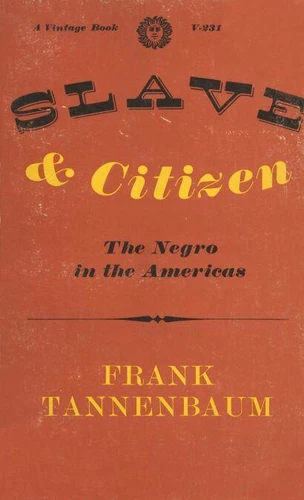
Slave & Citizen deals with one of the most intriguing problems presented by the development of the New World: the contrast between the legal and social positions of the Negro in the United States and in Latin America. It is well-known that in Brazil and in the Caribbean area, Negroes do not suffer legal or even major social disabilities on account of color, and that a long history of acceptance and miscegenation has erased the sharp line between white and colored.
Professor Tannenbaum, one of our leading authorities on Latin America, asks why there has been such a sharp distinction between the United States and the other parts of the New World into which Negroes were originally brought as slaves. In the legal structure of the United States, the Negro slave became property. There has been little experience with Negro slaves in England, and the ancient and medieval traditions affecting slavery had died out.
As property, the slave was without rights to marriage, to children, to the product of his work, or to freedom. In the Iberian peninsula, on the other hand, Negro slaves were common, and the laws affecting them were well developed. Therefore, in the colonies of Spain and Portugal, while the slave was the lowest person in the social order, he was still a human being, with some rights, and some means by which he might achieve freedom.
Only the United States made a radical split with the tradition in which all men, even slaves, had certain inalienable rights.
Slave & Citizen deals with one of the most intriguing problems presented by the development of the New World: the contrast between the legal and social positions of the Negro in the United States and in Latin America. It is well-known that in Brazil and in the Caribbean area, Negroes do not suffer legal or even major social disabilities on account of color, and that a long history of acceptance and miscegenation has erased the sharp line between white and colored.
Professor Tannenbaum, one of our leading authorities on Latin America, asks why there has been such a sharp distinction between the United States and the other parts of the New World into which Negroes were originally brought as slaves. In the legal structure of the United States, the Negro slave became property. There has been little experience with Negro slaves in England, and the ancient and medieval traditions affecting slavery had died out.
As property, the slave was without rights to marriage, to children, to the product of his work, or to freedom. In the Iberian peninsula, on the other hand, Negro slaves were common, and the laws affecting them were well developed. Therefore, in the colonies of Spain and Portugal, while the slave was the lowest person in the social order, he was still a human being, with some rights, and some means by which he might achieve freedom.
Only the United States made a radical split with the tradition in which all men, even slaves, had certain inalienable rights.

 , qui est-ce ?