An entrepreneur who scaled startups after early failures, offering self-help for resilience, business tactics on customer retention, and histories of entrepreneurial pivots during economic booms.
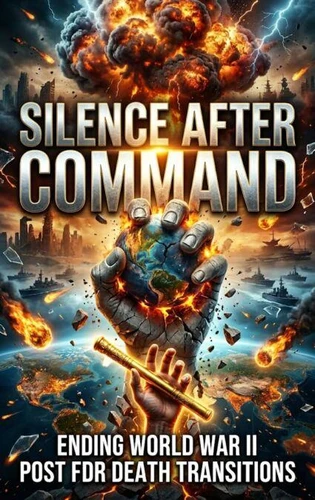
Silence After Command. Ending World War II post FDR Death Transitions
Par :Formats :
Disponible dans votre compte client Decitre ou Furet du Nord dès validation de votre commande. Le format ePub est :
- Compatible avec une lecture sur My Vivlio (smartphone, tablette, ordinateur)
- Compatible avec une lecture sur liseuses Vivlio
- Pour les liseuses autres que Vivlio, vous devez utiliser le logiciel Adobe Digital Edition. Non compatible avec la lecture sur les liseuses Kindle, Remarkable et Sony
 , qui est-ce ?
Notre partenaire de plateforme de lecture numérique où vous retrouverez l'ensemble de vos ebooks gratuitement
Pour en savoir plus sur nos ebooks, consultez notre aide en ligne ici
C'est si simple ! Lisez votre ebook avec l'app Vivlio sur votre tablette, mobile ou ordinateur :

- Nombre de pages228
- FormatePub
- ISBN978-3-565-40701-9
- EAN9783565407019
- Date de parution13/04/2026
- Protection num.pas de protection
- Taille2 Mo
- Infos supplémentairesepub
- ÉditeurEmphaloz Publishing House
Résumé
On the afternoon of April 12, 1945, Vice President Harry S. Truman was summoned urgently to the White House, where he learned that Franklin D. Roosevelt had died of a cerebral hemorrhage in Warm Springs, Georgia. Within hours, Truman raised his right hand and took the oath of office - a man who had been kept almost entirely out of the loop, unaware of the Manhattan Project, the atomic bomb program, or the full weight of diplomatic arrangements already in motion.
Roosevelt had spent twelve years guiding America through depression and war, shaping a vision of the postwar world through the Yalta Conference and the founding framework of the United Nations.
His death left not only a nation in mourning, but a presidency abruptly handed to a man who had scarcely seen Roosevelt during the weeks of his vice presidency. The world was in its final, violent spasm - Allied forces and the Soviet Red Army closing in on Berlin from both sides, while in the Pacific, Japan still refused to yield. What followed was among the most compressed and consequential periods in modern political history.
Within fifteen days of Truman's swearing-in, both Mussolini and Hitler were dead. Germany surrendered on May 8, 1945 - a day Truman received with quiet solemnity, knowing the burden of victory belonged to a man no longer alive to witness it. Then came the most fateful decision of his presidency: the atomic bombings of Hiroshima and Nagasaki, forcing Japan's surrender within days.
His death left not only a nation in mourning, but a presidency abruptly handed to a man who had scarcely seen Roosevelt during the weeks of his vice presidency. The world was in its final, violent spasm - Allied forces and the Soviet Red Army closing in on Berlin from both sides, while in the Pacific, Japan still refused to yield. What followed was among the most compressed and consequential periods in modern political history.
Within fifteen days of Truman's swearing-in, both Mussolini and Hitler were dead. Germany surrendered on May 8, 1945 - a day Truman received with quiet solemnity, knowing the burden of victory belonged to a man no longer alive to witness it. Then came the most fateful decision of his presidency: the atomic bombings of Hiroshima and Nagasaki, forcing Japan's surrender within days.
A propos de Corbin Holt











9,99 €