
Gavin Weightman is an experienced television documentary-maker (producer/director/writer), journalist and author of many books such as The Making of Modern London: 1815-1914, The Making of Modern London: 1914-1939, London River, Picture Post Britain and Rescue: A History of the British Emergency Services (Boxtree).
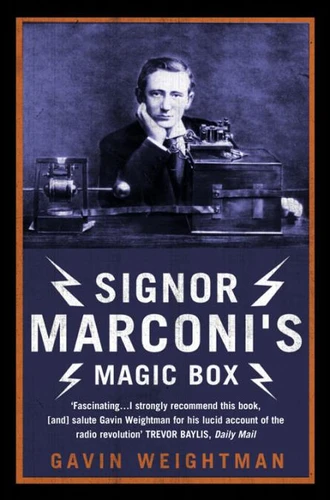
Signor Marconi’s Magic Box. The invention that sparked the radio revolution (Text Only)
Par :Formats :
Disponible dans votre compte client Decitre ou Furet du Nord dès validation de votre commande. Le format ePub protégé est :
- Compatible avec une lecture sur My Vivlio (smartphone, tablette, ordinateur)
- Compatible avec une lecture sur liseuses Vivlio
- Pour les liseuses autres que Vivlio, vous devez utiliser le logiciel Adobe Digital Edition. Non compatible avec la lecture sur les liseuses Kindle, Remarkable et Sony
- Non compatible avec un achat hors France métropolitaine
 , qui est-ce ?
Notre partenaire de plateforme de lecture numérique où vous retrouverez l'ensemble de vos ebooks gratuitement
Pour en savoir plus sur nos ebooks, consultez notre aide en ligne ici
C'est si simple ! Lisez votre ebook avec l'app Vivlio sur votre tablette, mobile ou ordinateur :

- Nombre de pages336
- FormatePub
- ISBN978-0-00-740225-0
- EAN9780007402250
- Date de parution29/03/2012
- Protection num.Adobe DRM
- Infos supplémentairesepub
- ÉditeurHarperCollins
Résumé
The intriguing story of how wireless was invented by Guglielmo Marconi - and how it amused Queen Victoria, saved the lives of the Titanic survivors, tracked down criminals and began the radio revolution.
Wireless was the most fabulous invention of the 19th century: the public thought it was magic, the popular newspapers regarded it as miraculous, and the leading scientists of the day (in Europe and America) could not understand how it worked.
In 1897, when the first wireless station was established by Marconi in a few rooms of the Royal Needles Hotel on the Isle of Wight, nobody knew how far these invisible waves could travel through the 'ether', carrying Morse Coded messages decipherable at a receiving station. (The definitive answer was not discovered till the 1920s, by which time radio had become a sophisticated industry filling the airwaves with a cacaphony of sounds - most of it American.) Note that it has not been possible to include the same picture content that appeared in the original print version.
Marconi himself was the son of an Italian father and an Irish mother (from the Jameson whiskey family); he grew up in Italy and was fluent in Italian and English, but it was in England that his invention first caught on. Marconi was in his early twenties at the time (he died in 1937). With the 'new telegraphy' came the real prospect of replacing the network of telegraphic cables that criss-crossed land and sea at colossal expense.
Initially it was the great ships that benefited from the new invention - including the Titanic, whose survivors owed their lives to the wireless.
In 1897, when the first wireless station was established by Marconi in a few rooms of the Royal Needles Hotel on the Isle of Wight, nobody knew how far these invisible waves could travel through the 'ether', carrying Morse Coded messages decipherable at a receiving station. (The definitive answer was not discovered till the 1920s, by which time radio had become a sophisticated industry filling the airwaves with a cacaphony of sounds - most of it American.) Note that it has not been possible to include the same picture content that appeared in the original print version.
Marconi himself was the son of an Italian father and an Irish mother (from the Jameson whiskey family); he grew up in Italy and was fluent in Italian and English, but it was in England that his invention first caught on. Marconi was in his early twenties at the time (he died in 1937). With the 'new telegraphy' came the real prospect of replacing the network of telegraphic cables that criss-crossed land and sea at colossal expense.
Initially it was the great ships that benefited from the new invention - including the Titanic, whose survivors owed their lives to the wireless.
A propos de Gavin Weightman

6,99 €