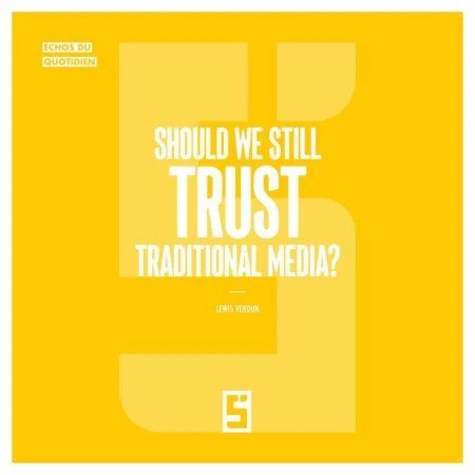
At a time when public confidence in the press is plummeting to historic lows, this short book draws on recent surveys to tackle a thorny question : can we still believe traditional media ? Drawing on research from Gallup, Pew Research, the Eurobarometer, the Digital News Report 2025 and the La Croix barometer, the author shows that only four in ten Europeans trust the media, that confidence has fallen to 28 % in the United States, while it reaches 68 % in Nigeria and 65 % in Kenya.
The book explores the causes of this fracture - political polarization, misinformation, influencers, the rise of artificial intelligence - and highlights the economic and democratic consequences of this crisis. This clear, well documented text also offers concrete ideas for rebuilding trust : valuing local media, investing in fact checking, developing media literacy and using AI ethically. It demonstrates that trust is not a relic of the past but a pact to be reinvented.
By the end, readers will have the tools to sharpen their critical faculties and demand that media adapt to digital habits without abandoning their democratic mission.
At a time when public confidence in the press is plummeting to historic lows, this short book draws on recent surveys to tackle a thorny question : can we still believe traditional media ? Drawing on research from Gallup, Pew Research, the Eurobarometer, the Digital News Report 2025 and the La Croix barometer, the author shows that only four in ten Europeans trust the media, that confidence has fallen to 28 % in the United States, while it reaches 68 % in Nigeria and 65 % in Kenya.
The book explores the causes of this fracture - political polarization, misinformation, influencers, the rise of artificial intelligence - and highlights the economic and democratic consequences of this crisis. This clear, well documented text also offers concrete ideas for rebuilding trust : valuing local media, investing in fact checking, developing media literacy and using AI ethically. It demonstrates that trust is not a relic of the past but a pact to be reinvented.
By the end, readers will have the tools to sharpen their critical faculties and demand that media adapt to digital habits without abandoning their democratic mission.

 , qui est-ce ?