
Francesco Mari is a postdoctoral researcher in Ancient History. He has pursued his research in Jerusalem and Berlin and is particularly interested in social interaction in archaic and classical Greece and diplomatic rituals in ancient international relations.
Christian Wendt is Professor of Ancient History at the Ruhr-Universität Bochum. His main research interests cover Ancient historiography (especially Thucydides), political thought in Antiquity, Ancient inter-State contact and the role of the sea in Ancient societies.
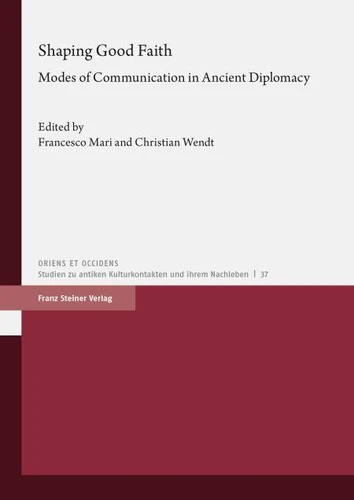
Shaping Good Faith. Modes of Communication in Ancient Diplomacy
Par : ,Formats :
Disponible dans votre compte client Decitre ou Furet du Nord dès validation de votre commande. Le format PDF est :
- Compatible avec une lecture sur My Vivlio (smartphone, tablette, ordinateur)
- Compatible avec une lecture sur liseuses Vivlio
- Pour les liseuses autres que Vivlio, vous devez utiliser le logiciel Adobe Digital Edition. Non compatible avec la lecture sur les liseuses Kindle, Remarkable et Sony
 , qui est-ce ?
Notre partenaire de plateforme de lecture numérique où vous retrouverez l'ensemble de vos ebooks gratuitement
Pour en savoir plus sur nos ebooks, consultez notre aide en ligne ici
C'est si simple ! Lisez votre ebook avec l'app Vivlio sur votre tablette, mobile ou ordinateur :

- Nombre de pages216
- FormatPDF
- ISBN978-3-515-12479-9
- EAN9783515124799
- Date de parution18/11/2021
- Protection num.Digital Watermarking
- Taille2 Mo
- Infos supplémentairespdf
- ÉditeurFranz Steiner
Résumé
The instauration of a bond of good faith between the parties played a crucial role in ancient diplomatic agreements. On the one hand, ancient authors often highlight the multi-faceted character of good faith and the ambiguities that marked many of the ritual practices used to create it. Yet it is precisely this complexity of good faith that paves the road for modern historians to enquire on aspects such as its legal implementation, its effectiveness in creating lasting bonds or its moral implications.
Forms of ancient diplomacy were often meaningful, and so were breaches of the diplomatic etiquette. The code of diplomatic communication was an extremely important channel for shaping policy (and good faith) and is therefore a fruitful heuristic tool for analysing interstate encounters in antiquity. The contributions collected in this volume offer a multifaceted, if preliminary, illustration of ancient diplomatic good faith, focusing primarily on Greek, Persian-Achaemenid, and Roman cultures, but also on the Hellenistic kingdoms and the Parthian Empire.
Forms of ancient diplomacy were often meaningful, and so were breaches of the diplomatic etiquette. The code of diplomatic communication was an extremely important channel for shaping policy (and good faith) and is therefore a fruitful heuristic tool for analysing interstate encounters in antiquity. The contributions collected in this volume offer a multifaceted, if preliminary, illustration of ancient diplomatic good faith, focusing primarily on Greek, Persian-Achaemenid, and Roman cultures, but also on the Hellenistic kingdoms and the Parthian Empire.