
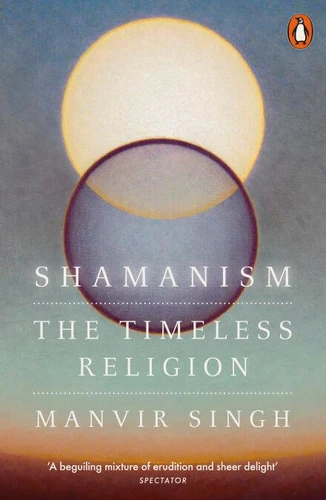
Shamanism. The Timeless Religion
Par :Formats :
Disponible dans votre compte client Decitre ou Furet du Nord dès validation de votre commande. Le format ePub protégé est :
- Compatible avec une lecture sur My Vivlio (smartphone, tablette, ordinateur)
- Compatible avec une lecture sur liseuses Vivlio
- Pour les liseuses autres que Vivlio, vous devez utiliser le logiciel Adobe Digital Edition. Non compatible avec la lecture sur les liseuses Kindle, Remarkable et Sony
- Non compatible avec un achat hors France métropolitaine
 , qui est-ce ?
Notre partenaire de plateforme de lecture numérique où vous retrouverez l'ensemble de vos ebooks gratuitement
Pour en savoir plus sur nos ebooks, consultez notre aide en ligne ici
C'est si simple ! Lisez votre ebook avec l'app Vivlio sur votre tablette, mobile ou ordinateur :

- Nombre de pages304
- FormatePub
- ISBN978-1-80206-289-2
- EAN9781802062892
- Date de parution20/05/2025
- Protection num.Adobe DRM
- Infos supplémentairesepub
- ÉditeurPenguin
Résumé
'Singh is a brilliant young scholar and a gifted writer, and this remarkable book will change how you think about religion, spirituality, consciousness, and human nature' Paul BloomWhat are the origins of shamanism and what is its future? Do shamans believe in their powers? What exactly is trance? And what can we learn from indigenous healing practices?In this enlightening book, anthropologist Manvir Singh offers a new explanation for one of the most misunderstood religious traditions.
Travelling from Indonesia to the Amazon, living with shamans and observing music, drug use and indigenous curing ceremonies, he journeys into the origins of shamanism. Fundamentally, shamans are specialists who use altered states to engage with unseen realities and provide services like healing and divination. As Singh shows, shamanism's ubiquity stems from its psychological resonance. Its core appeal is transformation: a specialist uses initiations, deprivation and non-ordinary states to seemingly become a different kind of human, one possessed with the superpowers necessary to tame life's uncertainty.
Following a fascinating cast of characters, Singh tells a larger story about the ancient and modern expressions of this timeless tradition. He argues that biomedicine can learn from shamanic practices, yet that psychedelic enthusiasts completely misrepresent history. He also shows that shamanic traditions will forever re-emerge - and that by journeying into humanity's oldest spiritual practice, we come to better understand ourselves, our history and our future.
Travelling from Indonesia to the Amazon, living with shamans and observing music, drug use and indigenous curing ceremonies, he journeys into the origins of shamanism. Fundamentally, shamans are specialists who use altered states to engage with unseen realities and provide services like healing and divination. As Singh shows, shamanism's ubiquity stems from its psychological resonance. Its core appeal is transformation: a specialist uses initiations, deprivation and non-ordinary states to seemingly become a different kind of human, one possessed with the superpowers necessary to tame life's uncertainty.
Following a fascinating cast of characters, Singh tells a larger story about the ancient and modern expressions of this timeless tradition. He argues that biomedicine can learn from shamanic practices, yet that psychedelic enthusiasts completely misrepresent history. He also shows that shamanic traditions will forever re-emerge - and that by journeying into humanity's oldest spiritual practice, we come to better understand ourselves, our history and our future.