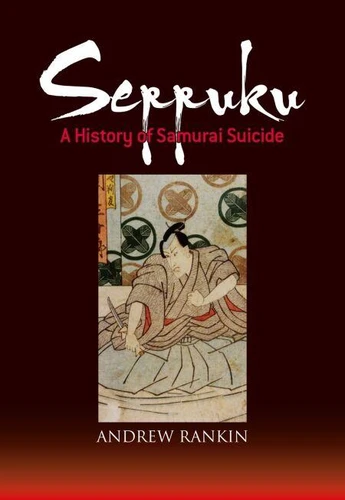
The history of seppuku-Japanese ritual suicide by cutting the stomach, sometimes referred to as hara-kiri-spans a millennium, and came to be favored by samurai as an honorable form of death. Here, for the first time in English, is a book that charts the history of seppuku from ancient times to the twentieth century through a collection of swashbuckling tales from history and literature. Author Andrew Rankin takes us from the first recorded incident of seppuku, by the goddess Aomi in the eighth century, through the "golden age" of seppuku in the sixteenth century that includes the suicides of Shibata Katsuie, Sen no Rikyu and Toyotomi Hidetsugu, up to the seppuku of General Nogi Maresuke in 1912.
Drawing on never-before-translated medieval war tales, samurai clan documents, and execution handbooks, Rankin also provides a fascinating look at the seppuku ritual itself, explaining the correct protocol and etiquette for seppuku, different stomach-cutting procedures, types of swords, attire, location, even what kinds of refreshment should be served at the seppuku ceremony. The book ends with a collection of quotations from authors and commentators down through the centuries, summing up both the Japanese attitude toward seppuku and foreigners' reactions:"As for when to die, make sure you are one step ahead of everyone else.
Never pull back from the brink. But be aware that there are times when you should die, and times when you should not. Die at the right moment, and you will be a hero. Die at the wrong moment, and you will die like a dog." - Izawa Nagahide, The Warrior's Code, 1725"We all thought, 'These guys are some kind of nutcakes.'" - Jim Verdolini, USS Randolph, describing "Kamikaze" attack of March 11, 1945
The history of seppuku-Japanese ritual suicide by cutting the stomach, sometimes referred to as hara-kiri-spans a millennium, and came to be favored by samurai as an honorable form of death. Here, for the first time in English, is a book that charts the history of seppuku from ancient times to the twentieth century through a collection of swashbuckling tales from history and literature. Author Andrew Rankin takes us from the first recorded incident of seppuku, by the goddess Aomi in the eighth century, through the "golden age" of seppuku in the sixteenth century that includes the suicides of Shibata Katsuie, Sen no Rikyu and Toyotomi Hidetsugu, up to the seppuku of General Nogi Maresuke in 1912.
Drawing on never-before-translated medieval war tales, samurai clan documents, and execution handbooks, Rankin also provides a fascinating look at the seppuku ritual itself, explaining the correct protocol and etiquette for seppuku, different stomach-cutting procedures, types of swords, attire, location, even what kinds of refreshment should be served at the seppuku ceremony. The book ends with a collection of quotations from authors and commentators down through the centuries, summing up both the Japanese attitude toward seppuku and foreigners' reactions:"As for when to die, make sure you are one step ahead of everyone else.
Never pull back from the brink. But be aware that there are times when you should die, and times when you should not. Die at the right moment, and you will be a hero. Die at the wrong moment, and you will die like a dog." - Izawa Nagahide, The Warrior's Code, 1725"We all thought, 'These guys are some kind of nutcakes.'" - Jim Verdolini, USS Randolph, describing "Kamikaze" attack of March 11, 1945


 , qui est-ce ?
