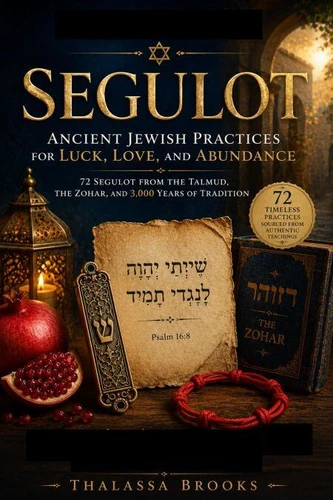
Ancient Jewish Secrets for Luck, Love, and Abundance - 72 Segulot from the Talmud, the Zohar, and 3, 000 Years of TraditionFor three thousand years, Jewish tradition has quietly practiced something most of the world only discovered recently: that small, deliberate acts - a bite of fruit, a knotted red thread, a psalm recited at exactly the right hour - can open doors that willpower alone cannot. They're called segulot.
Until now, most of what's written about them has stayed locked inside Hebrew texts, academic footnotes, and communities that never expected an outsider to come looking. You already know the feeling this book is for. The money that won't stretch no matter how carefully you plan it. The love that hasn't landed yet. The health that won't quite turn a corner. The home that never feels settled. You've already tried what you know how to try.
For centuries, people turned to these practices in the moments when ordinary answers stopped being enough. SEGULOT gathers 72 of these practices into one book, sourced from the Talmud, the Zohar, and rabbis whose names have been carried for centuries, and explains each one in plain English: the story behind it, where it comes from, exactly what to do, and a prayer you can say today. Each entry includes the original Hebrew source with transliteration and translation, so you're never more than one page away from the tradition itself.
Here's a taste of what's inside - and which of these you might have already brushed up against without knowing why. Madonna wore it. Britney Spears wore it. David Beckham wore it. Ariana Grande wore it. Harry Styles was photographed wearing one too. You've probably seen it without ever knowing where it came from. But the red string wasn't invented in Hollywood. Its story reaches back into Jewish tradition - to wool wound seven times around Rachel's Tomb in Bethlehem, and to the seven knots tied into the bracelet, each one carrying its own meaning.
The mezuzah - the small case fixed to a Jewish doorframe in millions of homes. Ask most people what the word actually means, and they won't know it's the identical word the Torah uses for the doorposts marked with blood on the night of the first Passover. Nobody invented a new custom here. It's the same word, doing the same job, three thousand years later. And here's one that's hard to shake once you know it: there's a psalm about safety, said for centuries right before bed, and in every version anyone has ever copied it into, it has never once contained the single Hebrew letter whose name means weapon.
Coincidence? Kabbalists have never thought so. All 72 are organized into eight parts: money, love, children, protection, health, home, travel, and the deepest layer of Jewish mysticism itself. Which one is yours right now?This isn't a book of superstition dressed up as spirituality. Every practice is honestly sourced, and where tradition itself has argued about whether something is genuine or just folklore, this book says so.
You don't need to be Jewish to use it. You don't need any background at all. These practices were carried for centuries by people who shared them freely, and they're offered here in the same spirit. Thalassa Brooks spent years gathering these segulot from Talmudic tractates, Zoharic passages, and rabbinical sources spanning five centuries - not as an academic exercise, but because she needed them.
She offers them the way they came to her: with honesty, with wonder, and with the full weight of where they come from. Open to any page. Begin where you're drawn. Try something a little older than you are.
Ancient Jewish Secrets for Luck, Love, and Abundance - 72 Segulot from the Talmud, the Zohar, and 3, 000 Years of TraditionFor three thousand years, Jewish tradition has quietly practiced something most of the world only discovered recently: that small, deliberate acts - a bite of fruit, a knotted red thread, a psalm recited at exactly the right hour - can open doors that willpower alone cannot. They're called segulot.
Until now, most of what's written about them has stayed locked inside Hebrew texts, academic footnotes, and communities that never expected an outsider to come looking. You already know the feeling this book is for. The money that won't stretch no matter how carefully you plan it. The love that hasn't landed yet. The health that won't quite turn a corner. The home that never feels settled. You've already tried what you know how to try.
For centuries, people turned to these practices in the moments when ordinary answers stopped being enough. SEGULOT gathers 72 of these practices into one book, sourced from the Talmud, the Zohar, and rabbis whose names have been carried for centuries, and explains each one in plain English: the story behind it, where it comes from, exactly what to do, and a prayer you can say today. Each entry includes the original Hebrew source with transliteration and translation, so you're never more than one page away from the tradition itself.
Here's a taste of what's inside - and which of these you might have already brushed up against without knowing why. Madonna wore it. Britney Spears wore it. David Beckham wore it. Ariana Grande wore it. Harry Styles was photographed wearing one too. You've probably seen it without ever knowing where it came from. But the red string wasn't invented in Hollywood. Its story reaches back into Jewish tradition - to wool wound seven times around Rachel's Tomb in Bethlehem, and to the seven knots tied into the bracelet, each one carrying its own meaning.
The mezuzah - the small case fixed to a Jewish doorframe in millions of homes. Ask most people what the word actually means, and they won't know it's the identical word the Torah uses for the doorposts marked with blood on the night of the first Passover. Nobody invented a new custom here. It's the same word, doing the same job, three thousand years later. And here's one that's hard to shake once you know it: there's a psalm about safety, said for centuries right before bed, and in every version anyone has ever copied it into, it has never once contained the single Hebrew letter whose name means weapon.
Coincidence? Kabbalists have never thought so. All 72 are organized into eight parts: money, love, children, protection, health, home, travel, and the deepest layer of Jewish mysticism itself. Which one is yours right now?This isn't a book of superstition dressed up as spirituality. Every practice is honestly sourced, and where tradition itself has argued about whether something is genuine or just folklore, this book says so.
You don't need to be Jewish to use it. You don't need any background at all. These practices were carried for centuries by people who shared them freely, and they're offered here in the same spirit. Thalassa Brooks spent years gathering these segulot from Talmudic tractates, Zoharic passages, and rabbinical sources spanning five centuries - not as an academic exercise, but because she needed them.
She offers them the way they came to her: with honesty, with wonder, and with the full weight of where they come from. Open to any page. Begin where you're drawn. Try something a little older than you are.

 , qui est-ce ?