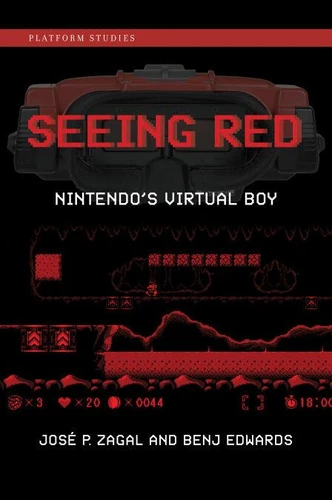
The curious history, technology, and technocultural context of Nintendo's short-lived stereoscopic gaming console, the Virtual Boy. With glowing red stereoscopic 3D graphics, the Virtual Boy cast a prophetic hue: Shortly after its release in 1995, Nintendo's balance sheet for the product was "in the red" as well. Of all the innovative long shots the game industry has witnessed over the years, perhaps the most infamous and least understood was the Virtual Boy.
Why the Virtual Boy failed, and where it succeeded, are questions that video game experts José Zagal and Benj Edwards explore in Seeing Red, but even more interesting to the authors is what the platform actually was: what it promised, how it worked, and where it fit into the story of gaming. Nintendo released the Virtual Boy as a standalone table-top device in 1995-and quickly discontinued it after lackluster sales and a lukewarm critical reception.
In Seeing Red, Zagal and Edwards examine the device's technical capabilities, its games, and the cultural context in the US in the 1990s when Nintendo developed and released the unusual console. The Virtual Boy, in their account, built upon and extended an often-forgotten historical tradition of immersive layered dioramas going back 100 years that was largely unexplored in video games at the time.
The authors also show how the platform's library of games conveyed a distinct visual aesthetic style that has not been significantly explored since the Virtual Boy's release, having been superseded by polygonal 3D graphics. The platform's meaning, they contend, lies as much in its design and technical capabilities and affordances as it does in an audience's perception of those capabilities. Offering rare insight into how we think about video game platforms, Seeing Red illustrates where perception and context come, quite literally, into play.
The curious history, technology, and technocultural context of Nintendo's short-lived stereoscopic gaming console, the Virtual Boy. With glowing red stereoscopic 3D graphics, the Virtual Boy cast a prophetic hue: Shortly after its release in 1995, Nintendo's balance sheet for the product was "in the red" as well. Of all the innovative long shots the game industry has witnessed over the years, perhaps the most infamous and least understood was the Virtual Boy.
Why the Virtual Boy failed, and where it succeeded, are questions that video game experts José Zagal and Benj Edwards explore in Seeing Red, but even more interesting to the authors is what the platform actually was: what it promised, how it worked, and where it fit into the story of gaming. Nintendo released the Virtual Boy as a standalone table-top device in 1995-and quickly discontinued it after lackluster sales and a lukewarm critical reception.
In Seeing Red, Zagal and Edwards examine the device's technical capabilities, its games, and the cultural context in the US in the 1990s when Nintendo developed and released the unusual console. The Virtual Boy, in their account, built upon and extended an often-forgotten historical tradition of immersive layered dioramas going back 100 years that was largely unexplored in video games at the time.
The authors also show how the platform's library of games conveyed a distinct visual aesthetic style that has not been significantly explored since the Virtual Boy's release, having been superseded by polygonal 3D graphics. The platform's meaning, they contend, lies as much in its design and technical capabilities and affordances as it does in an audience's perception of those capabilities. Offering rare insight into how we think about video game platforms, Seeing Red illustrates where perception and context come, quite literally, into play.


 , qui est-ce ?
