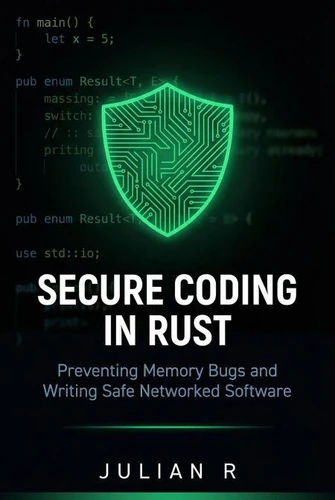
Secure Coding in Rust: Preventing Memory Bugs and Writing Safe Networked Software. Rust Development for Real-World Applications
Par :Formats :
Disponible dans votre compte client Decitre ou Furet du Nord dès validation de votre commande. Le format ePub protégé est :
- Compatible avec une lecture sur My Vivlio (smartphone, tablette, ordinateur)
- Compatible avec une lecture sur liseuses Vivlio
- Pour les liseuses autres que Vivlio, vous devez utiliser le logiciel Adobe Digital Edition. Non compatible avec la lecture sur les liseuses Kindle, Remarkable et Sony
- Non compatible avec un achat hors France métropolitaine
 , qui est-ce ?
Notre partenaire de plateforme de lecture numérique où vous retrouverez l'ensemble de vos ebooks gratuitement
Pour en savoir plus sur nos ebooks, consultez notre aide en ligne ici
C'est si simple ! Lisez votre ebook avec l'app Vivlio sur votre tablette, mobile ou ordinateur :

- FormatePub
- ISBN8233811029
- EAN9798233811029
- Date de parution27/03/2026
- Protection num.Adobe DRM
- Infos supplémentairesepub
- ÉditeurLinda Balsamo
Résumé
Memory corruption destroys real systems. Rust was built to stop it. Every year, roughly 70% of critical security patches address memory safety vulnerabilities. Yet writing code that compiles in Rust is only the first step. Logic flaws, injection attacks, and architectural gaps can still compromise a perfectly memory-safe application. Secure Coding in Rust bridges the gap between safe code and genuinely secure systems.
Grounded in adversarial thinking and real-world threat modeling, this book equips systems programmers, backend engineers, and security professionals to build production-grade software that resists determined attackers. What you will master: How Rust's ownership model and borrow checker eliminate buffer overflows and use-after-free vulnerabilities at compile time Defensive error handling, strict input validation, and data race-free concurrency patterns that close runtime attack vectors How to safely write, isolate, and formally verify unsafe code and FFI boundaries without introducing memory corruption Secure networking fundamentals: authentication, secrets management, serialization hardening, and injection prevention Coverage-guided fuzzing, static analysis, dependency auditing, and structured threat modeling Production hardening: distroless containers, syscall sandboxing, and structured incident observability Whether you are migrating from C or C++, building secure networked APIs, or auditing existing Rust infrastructure, this is your hands-on, progressive guide to engineering systems-level software that is both memory-safe and architecturally secure.
Stop writing code that merely compiles. Start engineering systems that cannot be broken.
Grounded in adversarial thinking and real-world threat modeling, this book equips systems programmers, backend engineers, and security professionals to build production-grade software that resists determined attackers. What you will master: How Rust's ownership model and borrow checker eliminate buffer overflows and use-after-free vulnerabilities at compile time Defensive error handling, strict input validation, and data race-free concurrency patterns that close runtime attack vectors How to safely write, isolate, and formally verify unsafe code and FFI boundaries without introducing memory corruption Secure networking fundamentals: authentication, secrets management, serialization hardening, and injection prevention Coverage-guided fuzzing, static analysis, dependency auditing, and structured threat modeling Production hardening: distroless containers, syscall sandboxing, and structured incident observability Whether you are migrating from C or C++, building secure networked APIs, or auditing existing Rust infrastructure, this is your hands-on, progressive guide to engineering systems-level software that is both memory-safe and architecturally secure.
Stop writing code that merely compiles. Start engineering systems that cannot be broken.