SOLDES
Jusqu'à -70% sur une sélection d'articles*

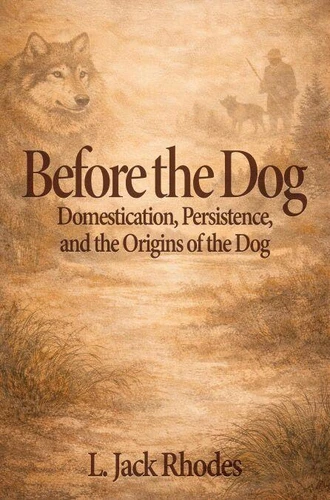
Search Before the Dog: Domestication, Persistence, and the Origins of the Dog
Par :Formats :
Disponible dans votre compte client Decitre ou Furet du Nord dès validation de votre commande. Le format ePub est :
- Compatible avec une lecture sur My Vivlio (smartphone, tablette, ordinateur)
- Compatible avec une lecture sur liseuses Vivlio
- Pour les liseuses autres que Vivlio, vous devez utiliser le logiciel Adobe Digital Edition. Non compatible avec la lecture sur les liseuses Kindle, Remarkable et Sony
 , qui est-ce ?
Notre partenaire de plateforme de lecture numérique où vous retrouverez l'ensemble de vos ebooks gratuitement
Pour en savoir plus sur nos ebooks, consultez notre aide en ligne ici
C'est si simple ! Lisez votre ebook avec l'app Vivlio sur votre tablette, mobile ou ordinateur :

- FormatePub
- ISBN8994932209
- EAN9798994932209
- Date de parution16/02/2026
- Protection num.pas de protection
- Infos supplémentairesepub
- ÉditeurA PRECISER
Résumé
Before the Dog offers a new account of how wolves became dogs-one that does not begin with taming, affection, or deliberate human design. Instead of asking when humans decided to domesticate wolves, this book asks a quieter question: how did certain canids manage to persist at the margins of human activity while others did not?Drawing on archaeology, paleopathology, evolutionary biology, behavioral ecology, and comparative neuroscience, the book reframes early domestication as a gradual ecological process shaped by survival, tolerance, and repeated filtering within human-altered landscapes.
In this account, dogs did not emerge because humans planned them, adopted them, or immediately benefited from them. They emerged because some individuals endured where others failed. Across thirteen chapters, Before the Dog develops a three-phase model of domestication:. Phase I: Wolves and humans overlap without recognition or partnership. Weak, asymmetric survival pressures begin to filter behavior..
Phase II: Persistence compounds across generations. Selection operates through attrition, non-removal, and tolerance, long before skeletal change or symbolism appears in the archaeological record.. Phase III: Difference becomes visible. Recognition stabilizes divergence, and only then do intentional roles, meaning, and partnership emerge. This framework explains why early domestication leaves little archaeological signal, why skeletal change appears late, why multiple origins are expected rather than exceptional, and why dramatic origin stories consistently mislead.
It also clarifies the evidentiary role of burial, spatial association, morphology, and healed injury-treating them as outcomes of altered survival rather than proof of early companionship. Rather than telling a story of sudden cooperation or emotional bonding, Before the Dog traces how tolerance, regulation, and differential survival reshaped wolf populations over deep time. Functional roles, symbolic meaning, and affection appear-but only after persistence has already done its work.
The result is a rigorous, evidence-driven, dog-centered account of domestication as an evolutionary mechanism. In showing how wolves became dogs without design, this book also challenges broader assumptions about how humans shape-and are shaped by-the animals that live alongside them. For readers interested in dog evolution, archaeology, behavioral ecology, and the deep history of human-animal relationships, Before the Dog offers a restrained, scientifically grounded alternative to familiar origin myths.
Where wolves lingered, dogs emerged.
In this account, dogs did not emerge because humans planned them, adopted them, or immediately benefited from them. They emerged because some individuals endured where others failed. Across thirteen chapters, Before the Dog develops a three-phase model of domestication:. Phase I: Wolves and humans overlap without recognition or partnership. Weak, asymmetric survival pressures begin to filter behavior..
Phase II: Persistence compounds across generations. Selection operates through attrition, non-removal, and tolerance, long before skeletal change or symbolism appears in the archaeological record.. Phase III: Difference becomes visible. Recognition stabilizes divergence, and only then do intentional roles, meaning, and partnership emerge. This framework explains why early domestication leaves little archaeological signal, why skeletal change appears late, why multiple origins are expected rather than exceptional, and why dramatic origin stories consistently mislead.
It also clarifies the evidentiary role of burial, spatial association, morphology, and healed injury-treating them as outcomes of altered survival rather than proof of early companionship. Rather than telling a story of sudden cooperation or emotional bonding, Before the Dog traces how tolerance, regulation, and differential survival reshaped wolf populations over deep time. Functional roles, symbolic meaning, and affection appear-but only after persistence has already done its work.
The result is a rigorous, evidence-driven, dog-centered account of domestication as an evolutionary mechanism. In showing how wolves became dogs without design, this book also challenges broader assumptions about how humans shape-and are shaped by-the animals that live alongside them. For readers interested in dog evolution, archaeology, behavioral ecology, and the deep history of human-animal relationships, Before the Dog offers a restrained, scientifically grounded alternative to familiar origin myths.
Where wolves lingered, dogs emerged.