
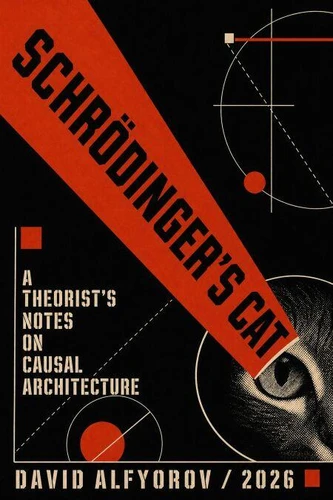
Schrödinger's CAT. The CAT Papers, #1
Par :Formats :
Disponible dans votre compte client Decitre ou Furet du Nord dès validation de votre commande. Le format ePub est :
- Compatible avec une lecture sur My Vivlio (smartphone, tablette, ordinateur)
- Compatible avec une lecture sur liseuses Vivlio
- Pour les liseuses autres que Vivlio, vous devez utiliser le logiciel Adobe Digital Edition. Non compatible avec la lecture sur les liseuses Kindle, Remarkable et Sony
 , qui est-ce ?
Notre partenaire de plateforme de lecture numérique où vous retrouverez l'ensemble de vos ebooks gratuitement
Pour en savoir plus sur nos ebooks, consultez notre aide en ligne ici
C'est si simple ! Lisez votre ebook avec l'app Vivlio sur votre tablette, mobile ou ordinateur :

- FormatePub
- ISBN978-1-80645-153-1
- EAN9781806451531
- Date de parution22/05/2026
- Protection num.pas de protection
- Infos supplémentairesepub
- ÉditeurPeter Farrar
Résumé
Inside this book: a theory of fundamental physics that, by some measurements, sits clearly alive. By others, very clearly dead. It is the working notebook of an independent researcher who built it from outside any university, any institute, any team. No grant. No PhD program. No postdocs. Just a hundred YouTube lectures, ten years of intuition with nowhere to put it, and the year that AI finally became good enough to be a research collaborator.
What's inside is half the story. The other half is what got cut, what failed, what kept the author up at night for half of 2026, what looked like a theorem for three months and then turned out not to be one. Most physics books polish that part out. This one doesn't. The chapters alternate between the formal physics and what the author calls naked notes: first-person, dated interludes about what he thought a year ago, what made him change his mind, what scared him, what he still doesn't know how to close.
They are the spine of the book, in the sense that they are the part that explains why the formal physics has the shape it has. It's for the reader who is tired of textbooks that read like everything was always obvious. For the reader who likes their physics with the working drafts still attached, the false starts visible, the changes of mind annotated. For the reader who wants to know which parts are real, which parts are conditional, and which parts the author would bet against if he were forced to bet.
It is not the book the field will eventually write about this material. That book, if it gets written, will be written by someone else, after the dust settles. This is the book one researcher could write in 2026, with the door behind him still open and the hardware still warm.
What's inside is half the story. The other half is what got cut, what failed, what kept the author up at night for half of 2026, what looked like a theorem for three months and then turned out not to be one. Most physics books polish that part out. This one doesn't. The chapters alternate between the formal physics and what the author calls naked notes: first-person, dated interludes about what he thought a year ago, what made him change his mind, what scared him, what he still doesn't know how to close.
They are the spine of the book, in the sense that they are the part that explains why the formal physics has the shape it has. It's for the reader who is tired of textbooks that read like everything was always obvious. For the reader who likes their physics with the working drafts still attached, the false starts visible, the changes of mind annotated. For the reader who wants to know which parts are real, which parts are conditional, and which parts the author would bet against if he were forced to bet.
It is not the book the field will eventually write about this material. That book, if it gets written, will be written by someone else, after the dust settles. This is the book one researcher could write in 2026, with the door behind him still open and the hardware still warm.