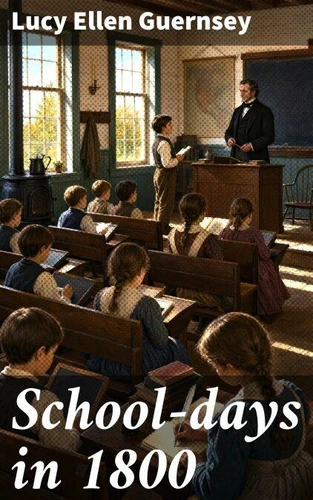
School-days in 1800: or, education as it was a century since is a reflective reconstruction of early nineteenth-century schooling, presenting the routines, discipline, curriculum, and social expectations that shaped childhood a hundred years before Guernsey's own time. Written in lucid, instructive prose, the book blends historical anecdote with moral commentary, a characteristic mode of nineteenth-century juvenile and domestic literature.
Its interest lies not only in the details of recitation, memorization, and classroom order, but also in its implicit comparison between past and modern educational ideals, making it part of a broader literature of social remembrance and reform. Lucy Ellen Guernsey was a prolific American writer of children's literature and religiously informed moral fiction, active in the nineteenth century. Her work frequently sought to educate as well as entertain, and this volume reflects her longstanding concern with the formation of character through home, school, and faith.
Guernsey's investment in historical instruction likely arose from her desire to make young readers conscious of cultural change while preserving lessons from an earlier generation. This book is especially recommended to readers interested in the history of education, childhood studies, and nineteenth-century didactic writing. It offers both a valuable historical portrait and a revealing example of how the past was interpreted for young readers by a thoughtful moral historian.
School-days in 1800: or, education as it was a century since is a reflective reconstruction of early nineteenth-century schooling, presenting the routines, discipline, curriculum, and social expectations that shaped childhood a hundred years before Guernsey's own time. Written in lucid, instructive prose, the book blends historical anecdote with moral commentary, a characteristic mode of nineteenth-century juvenile and domestic literature.
Its interest lies not only in the details of recitation, memorization, and classroom order, but also in its implicit comparison between past and modern educational ideals, making it part of a broader literature of social remembrance and reform. Lucy Ellen Guernsey was a prolific American writer of children's literature and religiously informed moral fiction, active in the nineteenth century. Her work frequently sought to educate as well as entertain, and this volume reflects her longstanding concern with the formation of character through home, school, and faith.
Guernsey's investment in historical instruction likely arose from her desire to make young readers conscious of cultural change while preserving lessons from an earlier generation. This book is especially recommended to readers interested in the history of education, childhood studies, and nineteenth-century didactic writing. It offers both a valuable historical portrait and a revealing example of how the past was interpreted for young readers by a thoughtful moral historian.

 , qui est-ce ?