Prof. Dr. Stephan Habscheid lehrt germanistische und angewandte Sprachwissenschaft an der Universität Siegen.
Dr. Heike Sahm ist Professorin für Germanistische Mediävistik / Ältere Deutsche Sprache und Literatur an der Universität Göttingen.
Prof. Dr. Gero Hoch lehrt Betriebswirtschaftslehre an der Universität Siegen.
Dr. Volker Stein ist Professor für Betriebswirtschaftlehre an der Universität Siegen und Vorstand der Universität Siegen Business School.
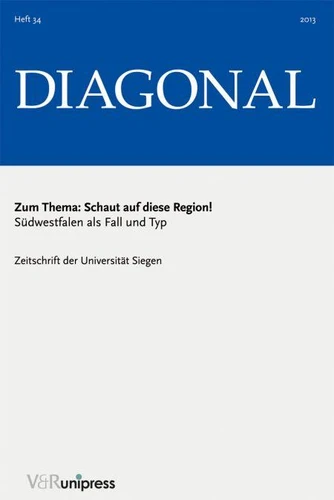
Schaut auf diese Region!. Südwestfalen als Fall und Typ. DIAGONAL, Jg. 2013
Par : , , ,Formats :
Disponible dans votre compte client Decitre ou Furet du Nord dès validation de votre commande. Le format PDF est :
- Compatible avec une lecture sur My Vivlio (smartphone, tablette, ordinateur)
- Compatible avec une lecture sur liseuses Vivlio
- Pour les liseuses autres que Vivlio, vous devez utiliser le logiciel Adobe Digital Edition. Non compatible avec la lecture sur les liseuses Kindle, Remarkable et Sony
 , qui est-ce ?
Notre partenaire de plateforme de lecture numérique où vous retrouverez l'ensemble de vos ebooks gratuitement
Pour en savoir plus sur nos ebooks, consultez notre aide en ligne ici
C'est si simple ! Lisez votre ebook avec l'app Vivlio sur votre tablette, mobile ou ordinateur :

- Nombre de pages294
- FormatPDF
- ISBN978-3-8470-0143-0
- EAN9783847001430
- Date de parution17/07/2013
- Protection num.pas de protection
- Taille8 Mo
- Infos supplémentairespdf
- ÉditeurV&R Unipress
Résumé
Be it the countryside, a town, or a metropolis - communication about our society often centres around spatial issues. In public discourse, key issues of the present day and the future (population growth, competition, climate change etc.) concern specific localities, and societal risks, challenges and potentials are defined within spatial contexts. Cities, villages, and other political and administrative units find themselves positioned within spatially structured ratings and rankings and compared and correlated with similar places elsewhere.
Against this background, they strive to shape their global competitive position strategically by defining and enhancing their particular strengths and putting across a positive image. Southern Westphalia, the youngest region in Germany, is currently attracting heightened public attention as the selected region for a structural development programme known as "Regionale 2013". Taking this region as an example, the contributions to this volume explore whether challenges and science-based solutions can be observed here that are also typical in other regions in Germany and beyond.
Should this be the case, then science should be able to give sustained support to collective learning processes by drawing attention to the commonalities and particularities of different regions.
Against this background, they strive to shape their global competitive position strategically by defining and enhancing their particular strengths and putting across a positive image. Southern Westphalia, the youngest region in Germany, is currently attracting heightened public attention as the selected region for a structural development programme known as "Regionale 2013". Taking this region as an example, the contributions to this volume explore whether challenges and science-based solutions can be observed here that are also typical in other regions in Germany and beyond.
Should this be the case, then science should be able to give sustained support to collective learning processes by drawing attention to the commonalities and particularities of different regions.
A propos de Stephan Habscheid
18,00 €