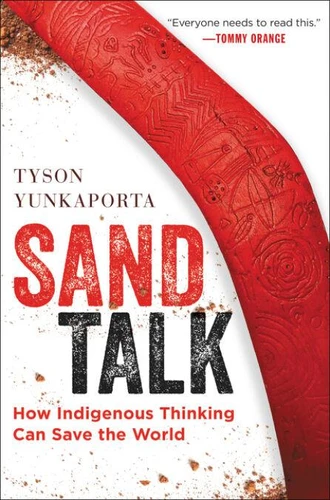
Sand Talk. How Indigenous Thinking Can Save the World
Par :Formats :
Disponible dans votre compte client Decitre ou Furet du Nord dès validation de votre commande. Le format ePub protégé est :
- Compatible avec une lecture sur My Vivlio (smartphone, tablette, ordinateur)
- Compatible avec une lecture sur liseuses Vivlio
- Pour les liseuses autres que Vivlio, vous devez utiliser le logiciel Adobe Digital Edition. Non compatible avec la lecture sur les liseuses Kindle, Remarkable et Sony
- Non compatible avec un achat hors France métropolitaine
 , qui est-ce ?
Notre partenaire de plateforme de lecture numérique où vous retrouverez l'ensemble de vos ebooks gratuitement
Pour en savoir plus sur nos ebooks, consultez notre aide en ligne ici
C'est si simple ! Lisez votre ebook avec l'app Vivlio sur votre tablette, mobile ou ordinateur :

- Nombre de pages336
- FormatePub
- ISBN978-0-06-297563-8
- EAN9780062975638
- Date de parution12/05/2020
- Protection num.Adobe DRM
- Infos supplémentairesepub
- ÉditeurHarperOne
Résumé
**Winner of the Randa and Sherif Nasr Book Prize on Religion & the World and the Australian Book Industry Small Publishers' Adult Book of the Year**A paradigm-shifting, award-winning book in the vein of Sapiens that brings a crucial Indigenous perspective to historical and cultural issues of history, education, money, power, and sustainability-and offers a new template for living. As an indigenous person, Tyson Yunkaporta looks at global systems from a unique perspective, one tied to the natural and spiritual world.
In considering how contemporary life diverges from the pattern of creation, he raises important questions. How does this affect us? How can we do things differently?In this thoughtful, culturally rich, mind-expanding book, he provides answers. Yunkaporta's writing process begins with images. Honoring indigenous traditions, he makes carvings of what he wants to say, channeling his thoughts through symbols and diagrams rather than words.
He yarns with people, looking for ways to connect images and stories with place and relationship to create a coherent world view, and he uses sand talk, the Aboriginal custom of drawing images on the ground to convey knowledge. In Sand Talk, he provides a new model for our everyday lives. Rich in ideas and inspiration, it explains how lines and symbols and shapes can help us make sense of the world.
It's about how we learn and how we remember. It's about talking to everyone and listening carefully. It's about finding different ways to look at things. Most of all it's about a very special way of thinking, of learning to see from a native perspective, one that is spiritually and physically tied to the earth around us, and how it can save our world. Sand Talk include 22 black-and-white illustrations that add depth to the text.
In considering how contemporary life diverges from the pattern of creation, he raises important questions. How does this affect us? How can we do things differently?In this thoughtful, culturally rich, mind-expanding book, he provides answers. Yunkaporta's writing process begins with images. Honoring indigenous traditions, he makes carvings of what he wants to say, channeling his thoughts through symbols and diagrams rather than words.
He yarns with people, looking for ways to connect images and stories with place and relationship to create a coherent world view, and he uses sand talk, the Aboriginal custom of drawing images on the ground to convey knowledge. In Sand Talk, he provides a new model for our everyday lives. Rich in ideas and inspiration, it explains how lines and symbols and shapes can help us make sense of the world.
It's about how we learn and how we remember. It's about talking to everyone and listening carefully. It's about finding different ways to look at things. Most of all it's about a very special way of thinking, of learning to see from a native perspective, one that is spiritually and physically tied to the earth around us, and how it can save our world. Sand Talk include 22 black-and-white illustrations that add depth to the text.