
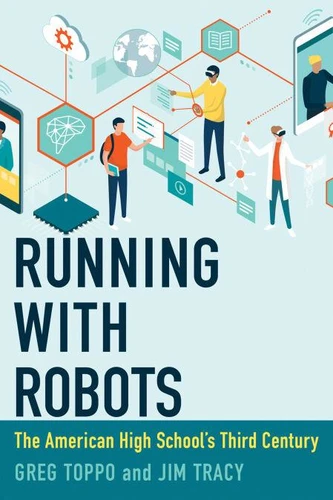
Running with Robots. The American High School's Third Century
Par : ,Formats :
Disponible dans votre compte client Decitre ou Furet du Nord dès validation de votre commande. Le format ePub protégé est :
- Compatible avec une lecture sur My Vivlio (smartphone, tablette, ordinateur)
- Compatible avec une lecture sur liseuses Vivlio
- Pour les liseuses autres que Vivlio, vous devez utiliser le logiciel Adobe Digital Edition. Non compatible avec la lecture sur les liseuses Kindle, Remarkable et Sony
- Non compatible avec un achat hors France métropolitaine
 , qui est-ce ?
Notre partenaire de plateforme de lecture numérique où vous retrouverez l'ensemble de vos ebooks gratuitement
Pour en savoir plus sur nos ebooks, consultez notre aide en ligne ici
C'est si simple ! Lisez votre ebook avec l'app Vivlio sur votre tablette, mobile ou ordinateur :

- Nombre de pages288
- FormatePub
- ISBN978-0-262-36572-7
- EAN9780262365727
- Date de parution28/09/2021
- Protection num.Adobe DRM
- Taille337 Ko
- Infos supplémentairesepub
- ÉditeurThe MIT Press
Résumé
EXPLORING AI IN EDUCATION: How the technological changes that are reshaping the future of work will transform the American high school as well. What will high school education look like in twenty years? High school students are educated today to take their places in a knowledge economy. But the knowledge economy, based on the assumption that information is a scarce and precious commodity, is giving way to an economy in which information is ubiquitous, digital, and machine-generated.
In Running with Robots, Greg Toppo and Jim Tracy show how the technological advances that are already changing the world of work will transform the American high school as well. Toppo and Tracy-a journalist and an education leader, respectively-look at developments in artificial intelligence and other fields that promise to bring us not only driverless cars but doctorless patients, lawyerless clients, and possibly even teacherless students.
They visit schools from New York City to Iowa that have begun preparing for this new world. Toppo and Tracy intersperse these reports from the present with bulletins from the future, telling the story of a high school principal who, Rip Van Winkle-style, sleeps for twenty years and, upon awakening in 2040, can hardly believe his eyes: the principal's amazingly efficient assistant is a robot, calculation is outsourced to computers, and students, grouped by competence and not grade level, focus on the conceptual.
The lesson to be learned from both the present and the book's thought-experiment future: human and robotic skillsets are complementary, not in competition. We can run with robots, not against them.
In Running with Robots, Greg Toppo and Jim Tracy show how the technological advances that are already changing the world of work will transform the American high school as well. Toppo and Tracy-a journalist and an education leader, respectively-look at developments in artificial intelligence and other fields that promise to bring us not only driverless cars but doctorless patients, lawyerless clients, and possibly even teacherless students.
They visit schools from New York City to Iowa that have begun preparing for this new world. Toppo and Tracy intersperse these reports from the present with bulletins from the future, telling the story of a high school principal who, Rip Van Winkle-style, sleeps for twenty years and, upon awakening in 2040, can hardly believe his eyes: the principal's amazingly efficient assistant is a robot, calculation is outsourced to computers, and students, grouped by competence and not grade level, focus on the conceptual.
The lesson to be learned from both the present and the book's thought-experiment future: human and robotic skillsets are complementary, not in competition. We can run with robots, not against them.