
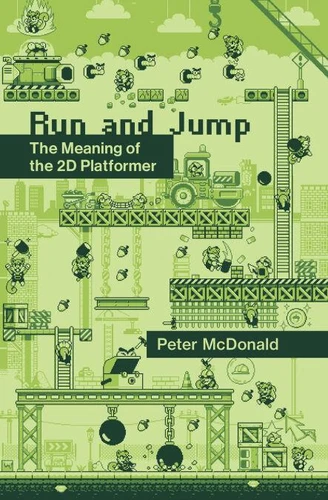
Run and Jump. The Meaning of the 2D Platformer
Par :Formats :
Disponible dans votre compte client Decitre ou Furet du Nord dès validation de votre commande. Le format ePub protégé est :
- Compatible avec une lecture sur My Vivlio (smartphone, tablette, ordinateur)
- Compatible avec une lecture sur liseuses Vivlio
- Pour les liseuses autres que Vivlio, vous devez utiliser le logiciel Adobe Digital Edition. Non compatible avec la lecture sur les liseuses Kindle, Remarkable et Sony
- Non compatible avec un achat hors France métropolitaine
 , qui est-ce ?
Notre partenaire de plateforme de lecture numérique où vous retrouverez l'ensemble de vos ebooks gratuitement
Pour en savoir plus sur nos ebooks, consultez notre aide en ligne ici
C'est si simple ! Lisez votre ebook avec l'app Vivlio sur votre tablette, mobile ou ordinateur :

- Nombre de pages184
- FormatePub
- ISBN978-0-262-37745-4
- EAN9780262377454
- Date de parution06/02/2024
- Protection num.Adobe DRM
- Taille2 Mo
- Infos supplémentairesepub
- ÉditeurThe MIT Press
Résumé
How abstract design decisions in 2D platform games create rich worlds of meaning for players. Since the 1980s, 2D platform games have captivated their audiences. Whether the player scrambles up the ladders in Donkey Kong or leaps atop an impossibly tall pipe in Super Mario Bros., this deceptively simple visual language has persisted in our cultural imagination of video games. In Run and Jump, Peter McDonald surveys the legacy of 2D platform games and examines how abstract and formal design choices have kept players playing.
McDonald argues that there is a rich layer of meaning underneath, say, the quality of an avatar's movement, the pacing and rhythm of level design, the personalities expressed by different enemies, and the emotion elicited by collecting a coin. To understand these games, McDonald draws on technical discussions by game designers as well as theoretical work about the nature of signs from structuralist semiotics.
Interspersed throughout are design exercises that show how critical interpretation can become a tool for game designers to communicate with their players. With examples drawn from over forty years of game history, and from games made by artists, hobbyists, iconic designers, and industry studios, Run and Jump presents a comprehensive-and engaging-vision of this slice of game history.
McDonald argues that there is a rich layer of meaning underneath, say, the quality of an avatar's movement, the pacing and rhythm of level design, the personalities expressed by different enemies, and the emotion elicited by collecting a coin. To understand these games, McDonald draws on technical discussions by game designers as well as theoretical work about the nature of signs from structuralist semiotics.
Interspersed throughout are design exercises that show how critical interpretation can become a tool for game designers to communicate with their players. With examples drawn from over forty years of game history, and from games made by artists, hobbyists, iconic designers, and industry studios, Run and Jump presents a comprehensive-and engaging-vision of this slice of game history.