
Nouveauté
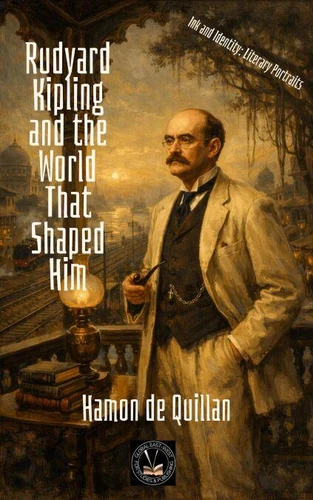
Rudyard Kipling and the World That Shaped Him. Ink & Identity
Par :Formats :
Disponible dans votre compte client Decitre ou Furet du Nord dès validation de votre commande. Le format ePub protégé est :
- Compatible avec une lecture sur My Vivlio (smartphone, tablette, ordinateur)
- Compatible avec une lecture sur liseuses Vivlio
- Pour les liseuses autres que Vivlio, vous devez utiliser le logiciel Adobe Digital Edition. Non compatible avec la lecture sur les liseuses Kindle, Remarkable et Sony
- Non compatible avec un achat hors France métropolitaine
 , qui est-ce ?
Notre partenaire de plateforme de lecture numérique où vous retrouverez l'ensemble de vos ebooks gratuitement
Pour en savoir plus sur nos ebooks, consultez notre aide en ligne ici
C'est si simple ! Lisez votre ebook avec l'app Vivlio sur votre tablette, mobile ou ordinateur :

- FormatePub
- ISBN8235574472
- EAN9798235574472
- Date de parution09/07/2026
- Protection num.Adobe DRM
- Infos supplémentairesepub
- ÉditeurIoakim Ioakim
Résumé
Few literary figures have generated as much admiration and controversy as Rudyard Kipling. Nobel Prize-winning author, journalist, poet, storyteller, and chronicler of the British Empire, Kipling occupies a unique place in world literature. His works continue to fascinate readers while raising profound questions about imperialism, identity, race, power, memory, and artistic responsibility. Rudyard Kipling and the World That Shaped Him presents a comprehensive study of Kipling's life and writings by placing them firmly within the historical environments that produced them.
Rather than isolating literature from history-or reducing literature to politics-this book demonstrates how biography, empire, journalism, technology, war, and personal experience intersect to shape one of the most remarkable literary careers of the modern era. The study follows Kipling from his childhood in colonial India through his years in Victorian England, his early journalistic apprenticeship in Lahore, his international literary success, and his later reflections on empire, memory, and loss.
Along the way, it examines major works, including Plain Tales from the Hills, Kim, The Jungle Books, Just So Stories, the Barrack-Room Ballads, and his later fiction, while also exploring his journalism, political writings, and evolving public reputation. The study pays special attention to the intellectual debates surrounding Kipling's legacy. Instead of presenting him as either hero or villain, the book encourages readers to understand the historical tensions that shaped both his achievements and his limitations.
It offers nuanced discussions of colonialism, postcolonial criticism, literary form, narrative technique, historical memory, and cultural influence. Ideal for university students, scholars, teachers, librarians, and thoughtful general readers, this volume provides a balanced and thoroughly researched introduction to one of English literature's most influential writers. It combines accessible prose with substantial scholarship, making it equally valuable as a classroom resource, a reference work, and a companion for anyone seeking a more profound understanding of Kipling and his enduring place in literary history.
Whether your interest lies in Victorian literature, imperial history, literary criticism, or cultural studies, this book offers a thoughtful and engaging exploration of Rudyard Kipling's extraordinary world and the lasting significance of his work.
Rather than isolating literature from history-or reducing literature to politics-this book demonstrates how biography, empire, journalism, technology, war, and personal experience intersect to shape one of the most remarkable literary careers of the modern era. The study follows Kipling from his childhood in colonial India through his years in Victorian England, his early journalistic apprenticeship in Lahore, his international literary success, and his later reflections on empire, memory, and loss.
Along the way, it examines major works, including Plain Tales from the Hills, Kim, The Jungle Books, Just So Stories, the Barrack-Room Ballads, and his later fiction, while also exploring his journalism, political writings, and evolving public reputation. The study pays special attention to the intellectual debates surrounding Kipling's legacy. Instead of presenting him as either hero or villain, the book encourages readers to understand the historical tensions that shaped both his achievements and his limitations.
It offers nuanced discussions of colonialism, postcolonial criticism, literary form, narrative technique, historical memory, and cultural influence. Ideal for university students, scholars, teachers, librarians, and thoughtful general readers, this volume provides a balanced and thoroughly researched introduction to one of English literature's most influential writers. It combines accessible prose with substantial scholarship, making it equally valuable as a classroom resource, a reference work, and a companion for anyone seeking a more profound understanding of Kipling and his enduring place in literary history.
Whether your interest lies in Victorian literature, imperial history, literary criticism, or cultural studies, this book offers a thoughtful and engaging exploration of Rudyard Kipling's extraordinary world and the lasting significance of his work.
A propos de Hamon de Quillan

Carbone
E-book
14,99 €

Carbon
E-book
14,99 €
14,99 €
A Kingdom of Paper
E-book
14,99 €
14,99 €


Un royaume de papier
E-book
14,99 €

Ghost. Black Label
E-book
14,99 €

Fantôme. Label noir
E-book
14,99 €


23,99 €
23,49 €

Synapse
E-book
17,49 €

14,49 €

15,49 €
Le Protocole Méridien
E-book
14,99 €