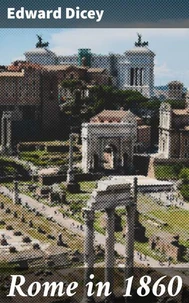
Rome in 1860
Par :Formats :
Disponible dans votre compte client Decitre ou Furet du Nord dès validation de votre commande. Le format ePub est :
- Compatible avec une lecture sur My Vivlio (smartphone, tablette, ordinateur)
- Compatible avec une lecture sur liseuses Vivlio
- Pour les liseuses autres que Vivlio, vous devez utiliser le logiciel Adobe Digital Edition. Non compatible avec la lecture sur les liseuses Kindle, Remarkable et Sony
 , qui est-ce ?
Notre partenaire de plateforme de lecture numérique où vous retrouverez l'ensemble de vos ebooks gratuitement
Pour en savoir plus sur nos ebooks, consultez notre aide en ligne ici
C'est si simple ! Lisez votre ebook avec l'app Vivlio sur votre tablette, mobile ou ordinateur :

- Nombre de pages134
- FormatePub
- ISBN859-65--4732998-5
- EAN8596547329985
- Date de parution16/09/2022
- Protection num.Digital Watermarking
- Taille434 Ko
- Infos supplémentairesepub
- ÉditeurDIGICAT
Résumé
In "Rome in 1860, " Edward Dicey masterfully chronicles the profound transformations occurring in Italian society and politics on the cusp of unification. Through a richly woven narrative interspersed with keen observations and vivid descriptions, Dicey captures the pulse of Rome during a pivotal year marked by social change, political fervor, and burgeoning nationalism. His journalistic style marries the aesthetic traditions of travel literature with incisive political commentary, offering readers a multifaceted understanding of Rome's evolution from papal rule to a unified state, set against the turbulent backdrop of 19th-century Europe.
Edward Dicey was a British journalist and writer whose experiences in Italy informed his acute insights into the complexities of the Italian unification process. His background in travel writing and his deep understanding of European political dynamics further enriched his perspective, allowing him to navigate the intricate tapestry of Italian life with both empathy and critical acumen. Dicey's immersion in the culture and politics of the period renders his observations not only timely but also deeply resonant in the context of contemporary discussions around national identity and statehood.
"Rome in 1860" is an essential read for historians, students of literature, and anyone keen to explore the confluence of travel writing and political discourse. Dicey's passionate examination not only illuminates a transformative epoch in Italian history but also serves as a timeless reflection on the intricate relationship between place, identity, and governance.
Edward Dicey was a British journalist and writer whose experiences in Italy informed his acute insights into the complexities of the Italian unification process. His background in travel writing and his deep understanding of European political dynamics further enriched his perspective, allowing him to navigate the intricate tapestry of Italian life with both empathy and critical acumen. Dicey's immersion in the culture and politics of the period renders his observations not only timely but also deeply resonant in the context of contemporary discussions around national identity and statehood.
"Rome in 1860" is an essential read for historians, students of literature, and anyone keen to explore the confluence of travel writing and political discourse. Dicey's passionate examination not only illuminates a transformative epoch in Italian history but also serves as a timeless reflection on the intricate relationship between place, identity, and governance.