SOLDES
Jusqu'à -70% sur une sélection d'articles*

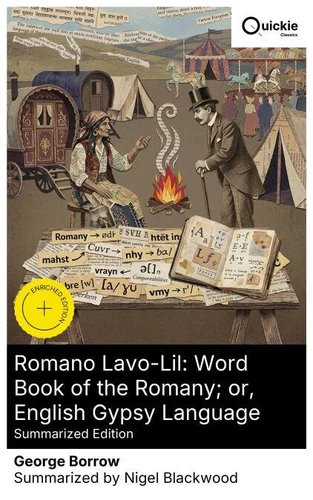
Romano Lavo-Lil: Word Book of the Romany; or, English Gypsy Language (Summarized Edition). Enriched edition. English Romany Phrases and Traditions in a 19th-Century Ethnolinguistic Guide
Par : , ,Formats :
Disponible dans votre compte client Decitre ou Furet du Nord dès validation de votre commande. Le format ePub est :
- Compatible avec une lecture sur My Vivlio (smartphone, tablette, ordinateur)
- Compatible avec une lecture sur liseuses Vivlio
- Pour les liseuses autres que Vivlio, vous devez utiliser le logiciel Adobe Digital Edition. Non compatible avec la lecture sur les liseuses Kindle, Remarkable et Sony
 , qui est-ce ?
Notre partenaire de plateforme de lecture numérique où vous retrouverez l'ensemble de vos ebooks gratuitement
Pour en savoir plus sur nos ebooks, consultez notre aide en ligne ici
C'est si simple ! Lisez votre ebook avec l'app Vivlio sur votre tablette, mobile ou ordinateur :

- Nombre de pages83
- FormatePub
- ISBN859-65--4788130-8
- EAN8596547881308
- Date de parution10/01/2026
- Protection num.Digital Watermarking
- Taille990 Ko
- Infos supplémentairesepub
- ÉditeurQUICKIE CLASSICS
Résumé
Romano Lavo-Lil; or, the Word-Book of the Romany condenses Borrow's lifetime with English Romany into a lively lexicon that mixes glossary entries with brief etymologies, idioms, and scenes from fairs and encampments. Colloquial yet erudite, it distinguishes Romany from English cant, notes pronunciation and grammar, and relates Sanskritic and European cognates. Its hybrid of word-book and ethnographic vignette sits squarely within Victorian comparative philology and folklore.
Born in Norfolk in 1803, George Borrow learned Romany among itinerant families and, as an agent of the British and Foreign Bible Society, honed his ear across Europe. The Zincali, Lavengro, and The Romany Rye trace those encounters. His field intimacy and hostility to armchair scholars led him to preserve vocabulary, correct confusions with thieves' cant, and memorialize a speech community under pressure.
Recommended to scholars of Romani studies, historical linguistics, and Victorian literature, Romano Lavo-Lil remains a primary source of lexicon in use. Allowing for period orthography and bias, readers will find a portable, engaging reference whose anecdotes and examples illuminate language, identity, and contact in nineteenth-century Britain. Quickie Classics summarizes timeless works with precision, preserving the author's voice and keeping the prose clear, fast, and readable-distilled, never diluted.
Enriched Edition extras: Introduction · Synopsis · Historical Context · Brief Analysis · 4 Reflection Q&As · Editorial Footnotes.
Born in Norfolk in 1803, George Borrow learned Romany among itinerant families and, as an agent of the British and Foreign Bible Society, honed his ear across Europe. The Zincali, Lavengro, and The Romany Rye trace those encounters. His field intimacy and hostility to armchair scholars led him to preserve vocabulary, correct confusions with thieves' cant, and memorialize a speech community under pressure.
Recommended to scholars of Romani studies, historical linguistics, and Victorian literature, Romano Lavo-Lil remains a primary source of lexicon in use. Allowing for period orthography and bias, readers will find a portable, engaging reference whose anecdotes and examples illuminate language, identity, and contact in nineteenth-century Britain. Quickie Classics summarizes timeless works with precision, preserving the author's voice and keeping the prose clear, fast, and readable-distilled, never diluted.
Enriched Edition extras: Introduction · Synopsis · Historical Context · Brief Analysis · 4 Reflection Q&As · Editorial Footnotes.
A propos de George Borrow


0,99 €
0,99 €
0,99 €
0,99 €
The Death of Balder
E-book
0,99 €
0,99 €
0,99 €
1,99 €

The Songs of Ranild
E-book
0,99 €
Ermeline a ballad
E-book
0,99 €