Daniel Defoe's Robinson Crusoe (1719) is at once an adventure narrative, spiritual autobiography, and foundational work of English prose fiction. Cast onto a remote island after shipwreck, Crusoe transforms apparent desolation into a disciplined experiment in survival, labor, property, and self-government. Defoe's plain, documentary style-rich in practical detail, economic calculation, and chronological precision-creates the persuasive illusion of a genuine memoir, while Crusoe's reflections on providence give the narrative a distinctly Protestant moral architecture.
The novel belongs to the early eighteenth-century rise of realistic fiction, yet its celebration of individual enterprise also exposes the assumptions of colonial expansion and mastery over nature and other peoples. A London merchant, journalist, political writer, and prolific pamphleteer, Defoe drew upon travel literature, spiritual autobiography, colonial accounts, and popular tales of maritime adventure.
His deep engagement with commerce, dissenting Protestantism, political controversy, and the expanding world of print helped shape a fiction concerned with money, risk, labor, repentance, and social order. Crusoe's voice reflects both Defoe's fascination with industrious self-fashioning and the period's confidence in empirical observation. Robinson Crusoe deserves recommendation not merely as an exciting survival story, but as a complex text through which readers can examine the origins of the modern novel and the cultural values that accompanied European empire.
It rewards historical reading while remaining vivid, accessible, and psychologically compelling.
This enriched edition has been carefully crafted to add value to your reading experience.
- A comprehensive Introduction outlines these selected works' unifying features, themes, or stylistic evolutions.
- The Author Biography highlights personal milestones and literary influences that shape the entire body of writing.
- A Historical Context section situates the works in their broader era-social currents, cultural trends, and key events that underpin their creation.
- A concise Synopsis (Selection) offers an accessible overview of the included texts, helping readers navigate plotlines and main ideas without revealing critical twists.
- A unified Analysis examines recurring motifs and stylistic hallmarks across the collection, tying the stories together while spotlighting the different work's strengths.
- Reflection questions inspire deeper contemplation of the author's overarching message, inviting readers to draw connections among different texts and relate them to modern contexts.
- Lastly, our hand-picked Memorable Quotes distill pivotal lines and turning points, serving as touchstones for the collection's central themes.
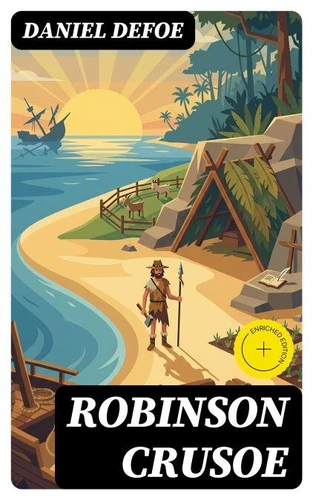
Daniel Defoe's Robinson Crusoe (1719) is at once an adventure narrative, spiritual autobiography, and foundational work of English prose fiction. Cast onto a remote island after shipwreck, Crusoe transforms apparent desolation into a disciplined experiment in survival, labor, property, and self-government. Defoe's plain, documentary style-rich in practical detail, economic calculation, and chronological precision-creates the persuasive illusion of a genuine memoir, while Crusoe's reflections on providence give the narrative a distinctly Protestant moral architecture.
The novel belongs to the early eighteenth-century rise of realistic fiction, yet its celebration of individual enterprise also exposes the assumptions of colonial expansion and mastery over nature and other peoples. A London merchant, journalist, political writer, and prolific pamphleteer, Defoe drew upon travel literature, spiritual autobiography, colonial accounts, and popular tales of maritime adventure.
His deep engagement with commerce, dissenting Protestantism, political controversy, and the expanding world of print helped shape a fiction concerned with money, risk, labor, repentance, and social order. Crusoe's voice reflects both Defoe's fascination with industrious self-fashioning and the period's confidence in empirical observation. Robinson Crusoe deserves recommendation not merely as an exciting survival story, but as a complex text through which readers can examine the origins of the modern novel and the cultural values that accompanied European empire.
It rewards historical reading while remaining vivid, accessible, and psychologically compelling.
This enriched edition has been carefully crafted to add value to your reading experience.
- A comprehensive Introduction outlines these selected works' unifying features, themes, or stylistic evolutions.
- The Author Biography highlights personal milestones and literary influences that shape the entire body of writing.
- A Historical Context section situates the works in their broader era-social currents, cultural trends, and key events that underpin their creation.
- A concise Synopsis (Selection) offers an accessible overview of the included texts, helping readers navigate plotlines and main ideas without revealing critical twists.
- A unified Analysis examines recurring motifs and stylistic hallmarks across the collection, tying the stories together while spotlighting the different work's strengths.
- Reflection questions inspire deeper contemplation of the author's overarching message, inviting readers to draw connections among different texts and relate them to modern contexts.
- Lastly, our hand-picked Memorable Quotes distill pivotal lines and turning points, serving as touchstones for the collection's central themes.


 , qui est-ce ?