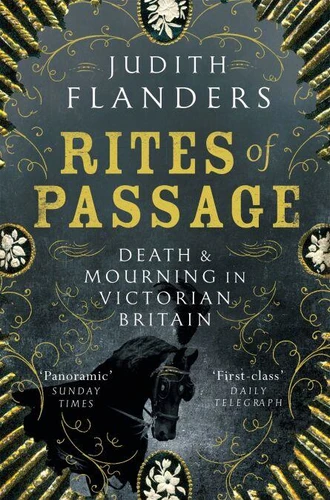
'There is no aspect of Victorian death that does not make it into Judith Flanders's latest investigation into 19th-century life' - The Sunday Times'Flanders writes with sharp intelligence and first-class scholarly attention to detail' - The TelegraphIn Rites of Passage, acclaimed historian Judith Flanders deconstructs the intricate, fascinating, and occasionally - to modern eyes - bizarre customs that grew up around death and mourning in Victorian Britain.
Through stories from the sickbed to the deathbed, from the correct way to grieve and to give comfort to those grieving, to funerals and burials and the reaction of those left behind, Flanders illuminates how living in nineteenth-century Britain was, in so many ways, dictated by dying. This is an engrossing, deeply researched and, at times, chilling social history of a period plagued by infant death, poverty, disease, and unprecedented change.
In elegant, often witty prose, Flanders brings the Victorian way of death vividly to life.
'There is no aspect of Victorian death that does not make it into Judith Flanders's latest investigation into 19th-century life' - The Sunday Times'Flanders writes with sharp intelligence and first-class scholarly attention to detail' - The TelegraphIn Rites of Passage, acclaimed historian Judith Flanders deconstructs the intricate, fascinating, and occasionally - to modern eyes - bizarre customs that grew up around death and mourning in Victorian Britain.
Through stories from the sickbed to the deathbed, from the correct way to grieve and to give comfort to those grieving, to funerals and burials and the reaction of those left behind, Flanders illuminates how living in nineteenth-century Britain was, in so many ways, dictated by dying. This is an engrossing, deeply researched and, at times, chilling social history of a period plagued by infant death, poverty, disease, and unprecedented change.
In elegant, often witty prose, Flanders brings the Victorian way of death vividly to life.