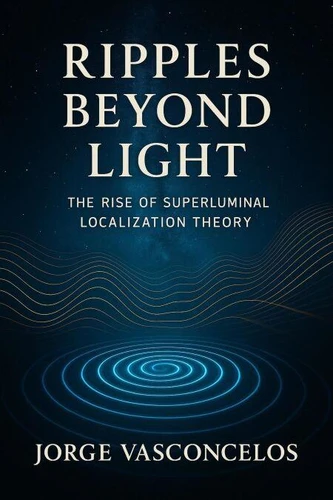
Ripples Beyond Light: The Rise of Superluminal Localization Theory introduces a bold scientific framework that seeks to harmonize General Relativity and Quantum Physics. At its core lies the proposition that spacetime itself is not fundamental, but rather a projection from a deeper causal substrate. This new perspective redefines causality, coherence, and localization - the cornerstones of how we understand the Universe.
Unlike speculative approaches, Superluminal Localization Theory (SLT) is anchored in three independent empirical domains: Quantum entanglement decay at orbital scales Pulsar timing deviations observed in long-term datasets Collider echo signatures emerging from high-energy experiments Together, these findings offer falsifiable evidence that points to a coherent, testable, and unified model of physical reality.
This book is written to be accessible yet rigorous. It blends clear explanations with formal reasoning, guiding readers through the crisis of fragmentation in modern physics, the conceptual foundations of SLT, and its implications for cosmology, determinism, and the philosophy of science. At the same time, the volume is intentionally sanitized: it presents the theoretical framework, empirical grounding, and philosophical implications, while withholding the proprietary operational mechanics required for technological applications.
That deeper operational layer remains reserved for future disclosures. For physicists, philosophers, and curious minds alike, Ripples Beyond Light is both an invitation and a challenge: an invitation to explore a theory that promises to unify the deepest rifts in science, and a challenge to test its predictions with data.
Ripples Beyond Light: The Rise of Superluminal Localization Theory introduces a bold scientific framework that seeks to harmonize General Relativity and Quantum Physics. At its core lies the proposition that spacetime itself is not fundamental, but rather a projection from a deeper causal substrate. This new perspective redefines causality, coherence, and localization - the cornerstones of how we understand the Universe.
Unlike speculative approaches, Superluminal Localization Theory (SLT) is anchored in three independent empirical domains: Quantum entanglement decay at orbital scales Pulsar timing deviations observed in long-term datasets Collider echo signatures emerging from high-energy experiments Together, these findings offer falsifiable evidence that points to a coherent, testable, and unified model of physical reality.
This book is written to be accessible yet rigorous. It blends clear explanations with formal reasoning, guiding readers through the crisis of fragmentation in modern physics, the conceptual foundations of SLT, and its implications for cosmology, determinism, and the philosophy of science. At the same time, the volume is intentionally sanitized: it presents the theoretical framework, empirical grounding, and philosophical implications, while withholding the proprietary operational mechanics required for technological applications.
That deeper operational layer remains reserved for future disclosures. For physicists, philosophers, and curious minds alike, Ripples Beyond Light is both an invitation and a challenge: an invitation to explore a theory that promises to unify the deepest rifts in science, and a challenge to test its predictions with data.


 , qui est-ce ?
