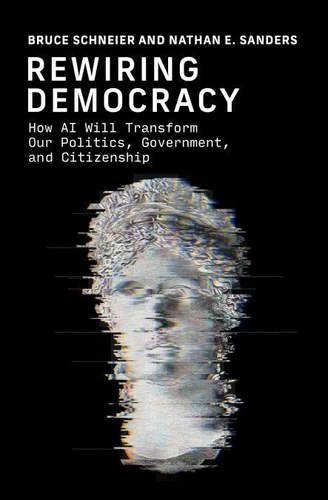
From the New York Times-bestselling author of The Hacker's Mind and Data & Goliath, an informative and wide-ranging exploration of how AI will alter every facet of democracy, and how to harness the technology to distribute rather than concentrate power. AI is changing democracy. We still get to decide how. AI's impact on democracy will go far beyond headline-grabbing political deepfakes and automated misinformation.
Everywhere it will be used, it will create risks and opportunities to shake up long-standing power structures. In this highly readable and advisedly optimistic book, Rewiring Democracy, security technologist Bruce Schneier and data scientist Nathan Sanders cut through the AI hype and examine the myriad ways that AI is transforming every aspect of democracy-for both good and ill. The authors describe how the sophistication of AI will fulfill demands from lawmakers for more complex legislation, reducing deference to the executive branch and altering the balance of power between lawmakers and administrators.
They show how the scale and scope of AI is enhancing civil servants' ability to shape private-sector behavior, automating either the enforcement or neglect of industry regulations. They also explain how both lawyers and judges will leverage the speed of AI, upending how we think about law enforcement, litigation, and dispute resolution. Whether these outcomes enhance or degrade democracy depends on how we shape the development and use of AI technologies.
Powerful players in private industry and public life are already using AI to increase their influence, and AIs built by corporations don't deliver the fairness and trust required by democratic governance. But, steered in the right direction, AI's broad capabilities can augment democratic processes and help citizens build consensus, express their voice, and shake up long-standing power structures. Democracy is facing new challenges worldwide, and AI has become a part of that.
It can inform, empower, and engage citizens. It can also disinform, disempower, and disengage them. The choice is up to us. Schneier and Sanders blaze the path forward, showing us how we can use AI to make democracy stronger and more participatory.
From the New York Times-bestselling author of The Hacker's Mind and Data & Goliath, an informative and wide-ranging exploration of how AI will alter every facet of democracy, and how to harness the technology to distribute rather than concentrate power. AI is changing democracy. We still get to decide how. AI's impact on democracy will go far beyond headline-grabbing political deepfakes and automated misinformation.
Everywhere it will be used, it will create risks and opportunities to shake up long-standing power structures. In this highly readable and advisedly optimistic book, Rewiring Democracy, security technologist Bruce Schneier and data scientist Nathan Sanders cut through the AI hype and examine the myriad ways that AI is transforming every aspect of democracy-for both good and ill. The authors describe how the sophistication of AI will fulfill demands from lawmakers for more complex legislation, reducing deference to the executive branch and altering the balance of power between lawmakers and administrators.
They show how the scale and scope of AI is enhancing civil servants' ability to shape private-sector behavior, automating either the enforcement or neglect of industry regulations. They also explain how both lawyers and judges will leverage the speed of AI, upending how we think about law enforcement, litigation, and dispute resolution. Whether these outcomes enhance or degrade democracy depends on how we shape the development and use of AI technologies.
Powerful players in private industry and public life are already using AI to increase their influence, and AIs built by corporations don't deliver the fairness and trust required by democratic governance. But, steered in the right direction, AI's broad capabilities can augment democratic processes and help citizens build consensus, express their voice, and shake up long-standing power structures. Democracy is facing new challenges worldwide, and AI has become a part of that.
It can inform, empower, and engage citizens. It can also disinform, disempower, and disengage them. The choice is up to us. Schneier and Sanders blaze the path forward, showing us how we can use AI to make democracy stronger and more participatory.


 , qui est-ce ?
