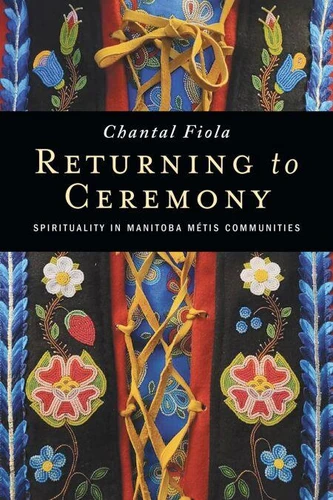
Returning to Ceremony. Spirituality in Manitoba Métis Communities
Par :Formats :
Disponible dans votre compte client Decitre ou Furet du Nord dès validation de votre commande. Le format ePub est :
- Compatible avec une lecture sur My Vivlio (smartphone, tablette, ordinateur)
- Compatible avec une lecture sur liseuses Vivlio
- Pour les liseuses autres que Vivlio, vous devez utiliser le logiciel Adobe Digital Edition. Non compatible avec la lecture sur les liseuses Kindle, Remarkable et Sony
 , qui est-ce ?
Notre partenaire de plateforme de lecture numérique où vous retrouverez l'ensemble de vos ebooks gratuitement
Pour en savoir plus sur nos ebooks, consultez notre aide en ligne ici
C'est si simple ! Lisez votre ebook avec l'app Vivlio sur votre tablette, mobile ou ordinateur :

- Nombre de pages336
- FormatePub
- ISBN978-0-88755-964-8
- EAN9780887559648
- Date de parution08/10/2021
- Protection num.Digital Watermarking
- Taille3 Mo
- Infos supplémentairesepub
- ÉditeurUniversity of Manitoba Press
Résumé
Returning to Ceremony is the follow-up to Chantal Fiola's award-winning Rekindling the Sacred Fire and continues her ground-breaking examination of Métis spirituality, debunking stereotypes such as "all Métis people are Catholic, " and "Métis people do not go to ceremonies." Fiola finds that, among the Métis, spirituality exists on a continuum of Indigenous and Christian traditions, and that Métis spirituality includes ceremonies.
For some Métis, it is a historical continuation of the relationships their ancestral communities have had with ceremonies since time immemorial, and for others, it is a homecoming-a return to ceremony after some time away. Fiola employs a Métis-specific and community-centred methodology to gather evidence from archives, priests' correspondence, oral history, storytelling, and literature. With assistance from six Métis community researchers, Fiola listened to stories and experiences shared by thirty-two Métis from six Manitoba Métis communities that are at the heart of this book.
They offer insight into their families' relationships with land, community, culture, and religion, including factors that inhibit or nurture connection to ceremonies such as sweat lodge, Sundance, and the Midewiwin. Valuable profiles emerge for six historic Red River Métis communities (Duck Bay, Camperville, St Laurent, St François-Xavier, Ste Anne, and Lorette), providing a clearer understanding of identity, culture, and spirituality that uphold Métis Nation sovereignty.
For some Métis, it is a historical continuation of the relationships their ancestral communities have had with ceremonies since time immemorial, and for others, it is a homecoming-a return to ceremony after some time away. Fiola employs a Métis-specific and community-centred methodology to gather evidence from archives, priests' correspondence, oral history, storytelling, and literature. With assistance from six Métis community researchers, Fiola listened to stories and experiences shared by thirty-two Métis from six Manitoba Métis communities that are at the heart of this book.
They offer insight into their families' relationships with land, community, culture, and religion, including factors that inhibit or nurture connection to ceremonies such as sweat lodge, Sundance, and the Midewiwin. Valuable profiles emerge for six historic Red River Métis communities (Duck Bay, Camperville, St Laurent, St François-Xavier, Ste Anne, and Lorette), providing a clearer understanding of identity, culture, and spirituality that uphold Métis Nation sovereignty.