
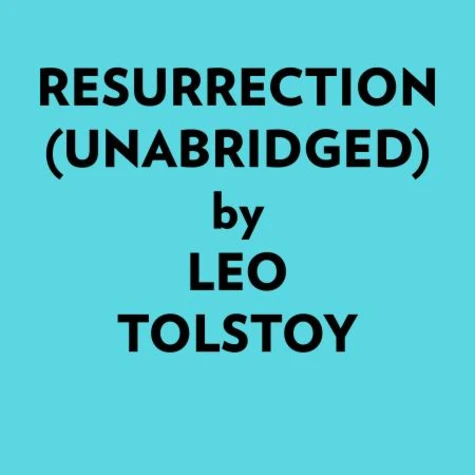
Resurrection (Unabridged)
Par : ,Formats :
Disponible dans votre compte client Decitre ou Furet du Nord dès validation de votre commande. Le format MP3 est :
- Pour les liseuses autres que Vivlio, vous devez utiliser le logiciel Adobe Digital Edition. Non compatible avec la lecture sur les liseuses Kindle, Remarkable et Sony
 , qui est-ce ?
Notre partenaire de plateforme de lecture numérique où vous retrouverez l'ensemble de vos ebooks gratuitement
Pour en savoir plus sur nos ebooks, consultez notre aide en ligne ici
C'est si simple ! Lisez votre ebook avec l'app Vivlio sur votre tablette, mobile ou ordinateur :

- FormatMP3
- ISBN978-1-6693-7103-8
- EAN9781669371038
- Date de parution04/04/2022
- Protection num.pas de protection
- Taille1535 Mo
- Infos supplémentairesaudio
- ÉditeurEverest Media LLC
Résumé
Please note: This audiobook has been created using AI voice.
Resurrection, the last fulllength novel written by Leo Tolstoy, was published in 1899 after ten years in the making. A humanitarian cause-the pacifist Doukhobor sect, persecuted by the Russian government, needed funds to emigrate to Canada-prompted Tolstoy to finish the novel and dedicate its ensuing revenues to alleviate their plight.
Ultimately, Tolstoy's actions were credited with helping hundreds of Doukhobors emigrate to Canada. The novel centers on the relationship between Nekhlúdoff, a Russian landlord, and Máslova, a prostitute whose life took a turn for the worse after Nekhlúdoff wronged her ten years prior to the novel's events. After Nekhlúdoff happens to sit in the jury for a trial in which Máslova is accused of poisoning a merchant, Nekhlúdoff begins to understand the harm he has inflicted upon Máslova-and the harm that the Russian state and society inflicts upon the poor and marginalized-as he embarks on a quest to alleviate Máslova's suffering. Nekhlúdoff's process of spiritual awakening in Resurrection serves as a framing for many of the novel's religious and political themes, such as the hypocrisy of State Christianity and the injustice of the penal system, which were also the subject of Tolstoy's nonfiction treatise on Christian anarchism, The Kingdom of God Is Within You.
The novel also explores the "single tax" economic theory propounded by the American economist Henry George, which drives a major subplot in the novel concerning the management of Nekhlúdoff's estates.
Ultimately, Tolstoy's actions were credited with helping hundreds of Doukhobors emigrate to Canada. The novel centers on the relationship between Nekhlúdoff, a Russian landlord, and Máslova, a prostitute whose life took a turn for the worse after Nekhlúdoff wronged her ten years prior to the novel's events. After Nekhlúdoff happens to sit in the jury for a trial in which Máslova is accused of poisoning a merchant, Nekhlúdoff begins to understand the harm he has inflicted upon Máslova-and the harm that the Russian state and society inflicts upon the poor and marginalized-as he embarks on a quest to alleviate Máslova's suffering. Nekhlúdoff's process of spiritual awakening in Resurrection serves as a framing for many of the novel's religious and political themes, such as the hypocrisy of State Christianity and the injustice of the penal system, which were also the subject of Tolstoy's nonfiction treatise on Christian anarchism, The Kingdom of God Is Within You.
The novel also explores the "single tax" economic theory propounded by the American economist Henry George, which drives a major subplot in the novel concerning the management of Nekhlúdoff's estates.
A propos de Leo Tolstoy


Childhood
E-book
2,99 €

0,99 €
1,99 €

War and Peace
E-book
0,99 €

What Is Art?
E-book
0,49 €
Resurrection
E-book
0,49 €

Hadji Murat
E-book
0,49 €

Youth
E-book
0,49 €
The Kreutzer Sonata
E-book
0,49 €

Boyhood
E-book
0,49 €

Family Happiness
E-book
0,49 €
Anna Karenina
E-book
0,49 €