SOLDES
Jusqu'à -70% sur une sélection d'articles*

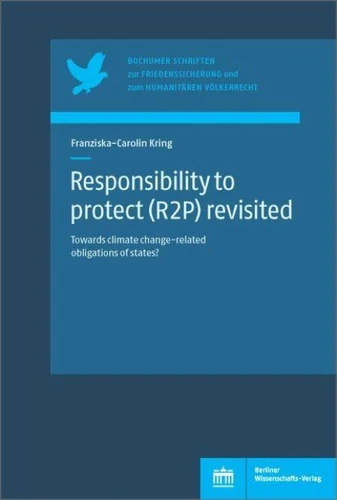
Responsibility to protect (R2P) revisited. Towards climate change-related obligations of states?
Par :Formats :
Disponible dans votre compte client Decitre ou Furet du Nord dès validation de votre commande. Le format PDF est :
- Compatible avec une lecture sur My Vivlio (smartphone, tablette, ordinateur)
- Compatible avec une lecture sur liseuses Vivlio
- Pour les liseuses autres que Vivlio, vous devez utiliser le logiciel Adobe Digital Edition. Non compatible avec la lecture sur les liseuses Kindle, Remarkable et Sony
 , qui est-ce ?
Notre partenaire de plateforme de lecture numérique où vous retrouverez l'ensemble de vos ebooks gratuitement
Pour en savoir plus sur nos ebooks, consultez notre aide en ligne ici
C'est si simple ! Lisez votre ebook avec l'app Vivlio sur votre tablette, mobile ou ordinateur :

- Nombre de pages312
- FormatPDF
- ISBN978-3-8305-4196-7
- EAN9783830541967
- Date de parution02/07/2020
- Protection num.Digital Watermarking
- Taille2 Mo
- Infos supplémentairespdf
- ÉditeurBWV
Résumé
Humanitarian catastrophes as a consequence of progressive climate change are one of the greatest challenges of the 21st century. Franziska Kring underlines the important role of the international community of states in combating and mitigating climate change.°°In her innovative approach, the author applies the concept of Responsibility to Protect (R2P), which was originally intended to prevent human rights violations, to climate change-related humanitarian catastrophes.
To this effect, she argues that state responses to such events correspond perfectly with the R2P framework. In particular, the understanding of state sovereignty as responsibility can be used as a theoretical basis for such commitments.°°The author concludes: Although a general obligation of states to take measures to mitigate climate change cannot be based on R2P, its application in the case of climate change-related humanitarian catastrophes is politically and morally justified.
To this effect, she argues that state responses to such events correspond perfectly with the R2P framework. In particular, the understanding of state sovereignty as responsibility can be used as a theoretical basis for such commitments.°°The author concludes: Although a general obligation of states to take measures to mitigate climate change cannot be based on R2P, its application in the case of climate change-related humanitarian catastrophes is politically and morally justified.