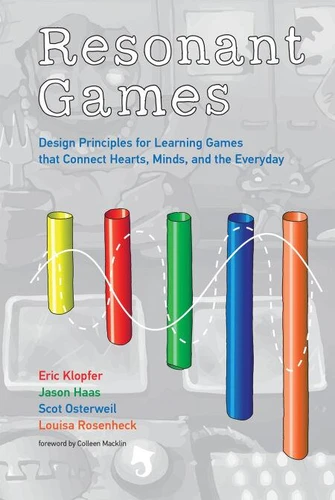
Resonant Games. Design Principles for Learning Games that Connect Hearts, Minds, and the Everyday
Par : , , , ,Formats :
Disponible dans votre compte client Decitre ou Furet du Nord dès validation de votre commande. Le format ePub protégé est :
- Compatible avec une lecture sur My Vivlio (smartphone, tablette, ordinateur)
- Compatible avec une lecture sur liseuses Vivlio
- Pour les liseuses autres que Vivlio, vous devez utiliser le logiciel Adobe Digital Edition. Non compatible avec la lecture sur les liseuses Kindle, Remarkable et Sony
- Non compatible avec un achat hors France métropolitaine
 , qui est-ce ?
Notre partenaire de plateforme de lecture numérique où vous retrouverez l'ensemble de vos ebooks gratuitement
Pour en savoir plus sur nos ebooks, consultez notre aide en ligne ici
C'est si simple ! Lisez votre ebook avec l'app Vivlio sur votre tablette, mobile ou ordinateur :

- Nombre de pages272
- FormatePub
- ISBN978-0-262-34608-5
- EAN9780262346085
- Date de parution17/07/2018
- Protection num.Adobe DRM
- Taille6 Mo
- Infos supplémentairesepub
- ÉditeurThe MIT Press
Résumé
Principles for designing educational games that integrate content and play and create learning experiences connecting to many areas of learners' lives. Too often educational videogames are narrowly focused on specific learning outcomes dictated by school curricula and fail to engage young learners. This book suggests another approach, offering a guide to designing games that integrates content and play and creates learning experiences that connect to many areas of learners' lives.
These games are not gamified workbooks but are embedded in a long-form experience of exploration, discovery, and collaboration that takes into consideration the learning environment. Resonant Games describes twenty essential principles for designing games that offer this kind of deeper learning experience, presenting them in connection with five games or collections of games developed at MIT's educational game research lab, the Education Arcade.
Each of the games-which range from Vanished, an alternate reality game for middle schoolers promoting STEM careers, to Ubiquitous Bio, a series of casual mobile games for high school biology students-has a different story, but all spring from these fundamental assumptions: honor the whole learner, as a full human being, not an empty vessel awaiting a fill-up; honor the sociality of learning and play; honor a deep connection between the content and the game; and honor the learning context-most often the public school classroom, but also beyond the classroom.
These games are not gamified workbooks but are embedded in a long-form experience of exploration, discovery, and collaboration that takes into consideration the learning environment. Resonant Games describes twenty essential principles for designing games that offer this kind of deeper learning experience, presenting them in connection with five games or collections of games developed at MIT's educational game research lab, the Education Arcade.
Each of the games-which range from Vanished, an alternate reality game for middle schoolers promoting STEM careers, to Ubiquitous Bio, a series of casual mobile games for high school biology students-has a different story, but all spring from these fundamental assumptions: honor the whole learner, as a full human being, not an empty vessel awaiting a fill-up; honor the sociality of learning and play; honor a deep connection between the content and the game; and honor the learning context-most often the public school classroom, but also beyond the classroom.