SOLDES
Jusqu'à -70% sur une sélection d'articles*

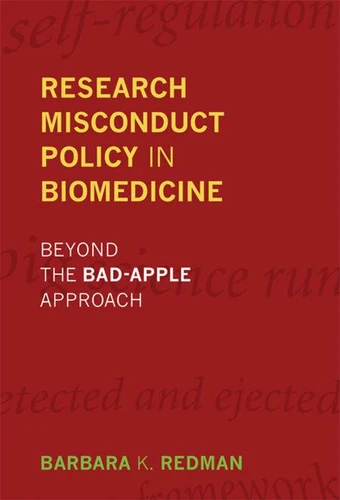
Research Misconduct Policy in Biomedicine. Beyond the Bad-Apple Approach
Par :Formats :
Disponible dans votre compte client Decitre ou Furet du Nord dès validation de votre commande. Le format ePub protégé est :
- Compatible avec une lecture sur My Vivlio (smartphone, tablette, ordinateur)
- Compatible avec une lecture sur liseuses Vivlio
- Pour les liseuses autres que Vivlio, vous devez utiliser le logiciel Adobe Digital Edition. Non compatible avec la lecture sur les liseuses Kindle, Remarkable et Sony
- Non compatible avec un achat hors France métropolitaine
 , qui est-ce ?
Notre partenaire de plateforme de lecture numérique où vous retrouverez l'ensemble de vos ebooks gratuitement
Pour en savoir plus sur nos ebooks, consultez notre aide en ligne ici
C'est si simple ! Lisez votre ebook avec l'app Vivlio sur votre tablette, mobile ou ordinateur :

- Nombre de pages208
- FormatePub
- ISBN978-0-262-31776-4
- EAN9780262317764
- Date de parution11/10/2013
- Protection num.Adobe DRM
- Taille207 Ko
- Infos supplémentairesepub
- ÉditeurThe MIT Press
Résumé
An analysis of current biomedical research misconduct policy that proposes a new approach emphasizing the context of misconduct and improved oversight. Federal regulations that govern research misconduct in biomedicine have not been able to prevent an ongoing series of high-profile cases of fabricating, falsifying, or plagiarizing scientific research. In this book, Barbara Redman looks critically at current research misconduct policy and proposes a new approach that emphasizes institutional context and improved oversight.
Current policy attempts to control risk at the individual level. But Redman argues that a fair and effective policy must reflect the context in which the behavior in question is embedded. As journalists who covered many research misconduct cases observed, the roots of fraud "lie in the barrel, not in the bad apples that occasionally roll into view." Drawing on literature in related fields-including moral psychology, the policy sciences, the organizational sciences, and law-as well as analyses of misconduct cases, Redman considers research misconduct from various perspectives.
She also examines in detail a series of clinical research cases in which repeated misconduct went undetected and finds laxity of oversight, little attention to harm done, and inadequate correction of the scientific record. Study questions enhance the book's value for graduate and professional courses in research ethics. Redman argues that the goals of any research misconduct policy should be to protect scientific capital (knowledge, scientists, institutions, norms of science), support fair competition, contain harms to end users and to the public trust, and enable science to meet its societal obligations.
Current policy attempts to control risk at the individual level. But Redman argues that a fair and effective policy must reflect the context in which the behavior in question is embedded. As journalists who covered many research misconduct cases observed, the roots of fraud "lie in the barrel, not in the bad apples that occasionally roll into view." Drawing on literature in related fields-including moral psychology, the policy sciences, the organizational sciences, and law-as well as analyses of misconduct cases, Redman considers research misconduct from various perspectives.
She also examines in detail a series of clinical research cases in which repeated misconduct went undetected and finds laxity of oversight, little attention to harm done, and inadequate correction of the scientific record. Study questions enhance the book's value for graduate and professional courses in research ethics. Redman argues that the goals of any research misconduct policy should be to protect scientific capital (knowledge, scientists, institutions, norms of science), support fair competition, contain harms to end users and to the public trust, and enable science to meet its societal obligations.