
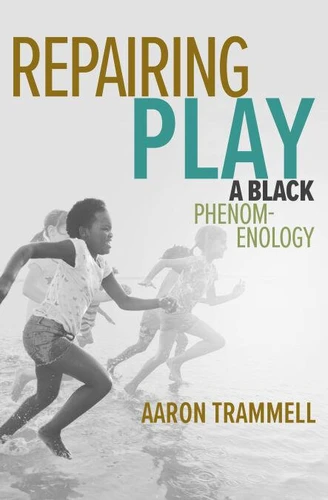
Repairing Play. A Black Phenomenology
Par :Formats :
Disponible dans votre compte client Decitre ou Furet du Nord dès validation de votre commande. Le format ePub protégé est :
- Compatible avec une lecture sur My Vivlio (smartphone, tablette, ordinateur)
- Compatible avec une lecture sur liseuses Vivlio
- Pour les liseuses autres que Vivlio, vous devez utiliser le logiciel Adobe Digital Edition. Non compatible avec la lecture sur les liseuses Kindle, Remarkable et Sony
- Non compatible avec un achat hors France métropolitaine
 , qui est-ce ?
Notre partenaire de plateforme de lecture numérique où vous retrouverez l'ensemble de vos ebooks gratuitement
Pour en savoir plus sur nos ebooks, consultez notre aide en ligne ici
C'est si simple ! Lisez votre ebook avec l'app Vivlio sur votre tablette, mobile ou ordinateur :

- Nombre de pages144
- FormatePub
- ISBN978-0-262-37387-6
- EAN9780262373876
- Date de parution07/02/2023
- Protection num.Adobe DRM
- Taille325 Ko
- Infos supplémentairesepub
- ÉditeurThe MIT Press
Résumé
A provocative study that reconsiders our notion of play-and how its deceptively wholesome image has harmed and erased people of color. Contemporary theorists present play as something wholly constructive and positive. But this broken definition is drawn from a White European philosophical tradition that ignores the fact that play can, and often does, hurt. In fact, this narrow understanding of play has been complicit in the systemic erasure of Black, Indigenous, and People of Color (BIPOC) from the domain of leisure.
In this book, Aaron Trammell proposes a corrective: a radical reconsideration of play that expands its definition to include BIPOC suffering, subjugation, and taboo topics such as torture. As he challenges and decolonizes White European thought, Trammell maps possible ways to reconcile existing theories with the fact that play is often hurtful and toxic. Trammell upends current notions by exploring play's function as a tool in the subjugation of BIPOC.
As he shows, the phenomenology of play is a power relationship. Even in innocent play, human beings subtly discipline each other to remain within unspoken rules. Going further, Trammell departs from mainstream theory to insist that torture can be play. Approaching it as such reveals play's role in subjugating people in general and renders visible the long-ignored experiences of BIPOC. Such an inclusive definition of play becomes a form of intellectual reparation, correcting the notion that play must give pleasure while also recasting play in a form that focuses on the deep, painful, and sometimes traumatic depths of living.
In this book, Aaron Trammell proposes a corrective: a radical reconsideration of play that expands its definition to include BIPOC suffering, subjugation, and taboo topics such as torture. As he challenges and decolonizes White European thought, Trammell maps possible ways to reconcile existing theories with the fact that play is often hurtful and toxic. Trammell upends current notions by exploring play's function as a tool in the subjugation of BIPOC.
As he shows, the phenomenology of play is a power relationship. Even in innocent play, human beings subtly discipline each other to remain within unspoken rules. Going further, Trammell departs from mainstream theory to insist that torture can be play. Approaching it as such reveals play's role in subjugating people in general and renders visible the long-ignored experiences of BIPOC. Such an inclusive definition of play becomes a form of intellectual reparation, correcting the notion that play must give pleasure while also recasting play in a form that focuses on the deep, painful, and sometimes traumatic depths of living.