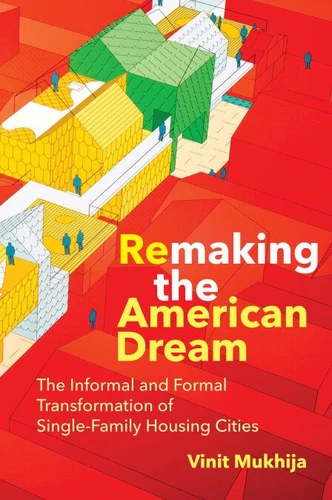
The redefinition of the single-family house, the urban landscape, and the American Dream. Sitting squarely at the center of the American Dream, the detached single-family home has long been the basic building block of most US cities. In Remaking the American Dream, Vinit Mukhija considers how this is changing, in both the American psyche and the urban landscape. In defiance of long-held norms and standards, single-family housing is slowly but significantly transforming through incremental additions of second and third units.
Drawing on empirical evidence of informal and formal changes, Remaking the American Dream documents homeowners' quiet unpermitted modifications, conversions, and workarounds, as well as gradual institutional alterations to once-rigid local land-use regulations. Mukhija's primary case study is Los Angeles and the role played by the State of California-findings he contrasts with the experience of other cities including Santa Cruz, Seattle, Portland, Minneapolis, and Vancouver.
In each instance, he shows how, and asks why, homeowners are adapting their homes and governments are changing the rules that regulate single-family housing to allow for accessory dwelling units (ADUs) or second units. Key to Mukhija's research is the question of why the idea of single-family living is changing and what this means for the future of US cities. The answer, this book suggests, heralds nothing less than a redefinition of American urbanism-and the American Dream.
The redefinition of the single-family house, the urban landscape, and the American Dream. Sitting squarely at the center of the American Dream, the detached single-family home has long been the basic building block of most US cities. In Remaking the American Dream, Vinit Mukhija considers how this is changing, in both the American psyche and the urban landscape. In defiance of long-held norms and standards, single-family housing is slowly but significantly transforming through incremental additions of second and third units.
Drawing on empirical evidence of informal and formal changes, Remaking the American Dream documents homeowners' quiet unpermitted modifications, conversions, and workarounds, as well as gradual institutional alterations to once-rigid local land-use regulations. Mukhija's primary case study is Los Angeles and the role played by the State of California-findings he contrasts with the experience of other cities including Santa Cruz, Seattle, Portland, Minneapolis, and Vancouver.
In each instance, he shows how, and asks why, homeowners are adapting their homes and governments are changing the rules that regulate single-family housing to allow for accessory dwelling units (ADUs) or second units. Key to Mukhija's research is the question of why the idea of single-family living is changing and what this means for the future of US cities. The answer, this book suggests, heralds nothing less than a redefinition of American urbanism-and the American Dream.

 , qui est-ce ?
