SOLDES
Jusqu'à -70% sur une sélection d'articles*

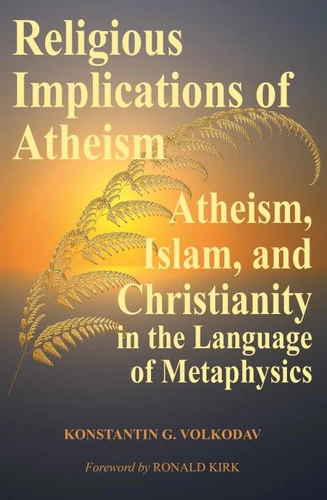
Religious Implications of Atheism: Atheism, Islam, and Christianity in the Language of Metaphysics
Par :Formats :
Disponible dans votre compte client Decitre ou Furet du Nord dès validation de votre commande. Le format ePub est :
- Compatible avec une lecture sur My Vivlio (smartphone, tablette, ordinateur)
- Compatible avec une lecture sur liseuses Vivlio
- Pour les liseuses autres que Vivlio, vous devez utiliser le logiciel Adobe Digital Edition. Non compatible avec la lecture sur les liseuses Kindle, Remarkable et Sony
 , qui est-ce ?
Notre partenaire de plateforme de lecture numérique où vous retrouverez l'ensemble de vos ebooks gratuitement
Pour en savoir plus sur nos ebooks, consultez notre aide en ligne ici
C'est si simple ! Lisez votre ebook avec l'app Vivlio sur votre tablette, mobile ou ordinateur :

- FormatePub
- ISBN978-1-005-79854-3
- EAN9781005798543
- Date de parution07/07/2021
- Protection num.pas de protection
- Infos supplémentairesepub
- ÉditeurC. C. Chamberlane
Résumé
This book is devoted to finding answers to the main existential questions of every human's life: who am I ontologically, do I have a higher purpose? These are the very "eternal questions" that make a human being human, the ability to ask them distinguishes a human from all other creatures in the universe. From time immemorial, people have argued about the criteria of truth, about the meaning of human life, and about the nature of things.
Usually this was expressed in disputes between religions. About two hundred years ago, atheism arose in Christian Europe and began to take part in these controversies. For two hundred years, there have already been thousands of disputes on the topic "Religion and Atheism", in which, as a rule, representatives of Christianity or Islam speak about religion. However, to analyze them abstractly, in general, would not be entirely correct.
Therefore, here we will comment on one specific dispute, by the example of which we will try to reveal the essence of all similar disputes. This is a debate between a representative of Atheism and a representative of Islam. In addition, we will comment on the basis of the Christian worldview. Thus, a trialogue will be presented here-three points of view, and the discussed problems will be shown as if "three-dimensionally".
This book formulates the Particular Principle of Causality (the Phenomenon of Creativity), which serves as a solid foundation for any kind of evidence of the existence of God. It's almost impossible to dispute. This principle is formulated for the first time in the book. The book also explores aspects of theodicy that have been a stumbling block for theologians throughout the centuries. In addition, many other important theological topics here are illuminated from unusual perspectives.
Quite often, atheists oppose their concept to religions. However, a detailed analysis of the metaphysics of the atheistic worldview shows that atheism has all the properties and features of religion. This book intelligently explains that Atheism is a religion of unbelief. The book is written in simple language and can be useful to many people who hesitate on the verge of faith and unbelief.
Usually this was expressed in disputes between religions. About two hundred years ago, atheism arose in Christian Europe and began to take part in these controversies. For two hundred years, there have already been thousands of disputes on the topic "Religion and Atheism", in which, as a rule, representatives of Christianity or Islam speak about religion. However, to analyze them abstractly, in general, would not be entirely correct.
Therefore, here we will comment on one specific dispute, by the example of which we will try to reveal the essence of all similar disputes. This is a debate between a representative of Atheism and a representative of Islam. In addition, we will comment on the basis of the Christian worldview. Thus, a trialogue will be presented here-three points of view, and the discussed problems will be shown as if "three-dimensionally".
This book formulates the Particular Principle of Causality (the Phenomenon of Creativity), which serves as a solid foundation for any kind of evidence of the existence of God. It's almost impossible to dispute. This principle is formulated for the first time in the book. The book also explores aspects of theodicy that have been a stumbling block for theologians throughout the centuries. In addition, many other important theological topics here are illuminated from unusual perspectives.
Quite often, atheists oppose their concept to religions. However, a detailed analysis of the metaphysics of the atheistic worldview shows that atheism has all the properties and features of religion. This book intelligently explains that Atheism is a religion of unbelief. The book is written in simple language and can be useful to many people who hesitate on the verge of faith and unbelief.