
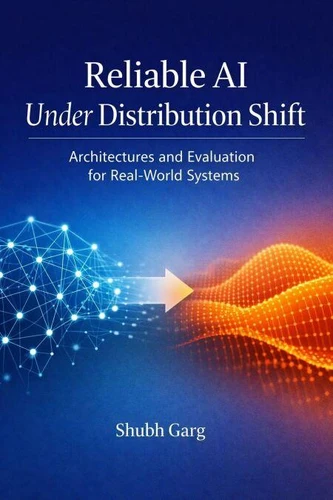
Reliable AI Under Distribution Shift: Architectures and Evaluation for Real-World Systems
Par :Formats :
Disponible dans votre compte client Decitre ou Furet du Nord dès validation de votre commande. Le format ePub est :
- Compatible avec une lecture sur My Vivlio (smartphone, tablette, ordinateur)
- Compatible avec une lecture sur liseuses Vivlio
- Pour les liseuses autres que Vivlio, vous devez utiliser le logiciel Adobe Digital Edition. Non compatible avec la lecture sur les liseuses Kindle, Remarkable et Sony
 , qui est-ce ?
Notre partenaire de plateforme de lecture numérique où vous retrouverez l'ensemble de vos ebooks gratuitement
Pour en savoir plus sur nos ebooks, consultez notre aide en ligne ici
C'est si simple ! Lisez votre ebook avec l'app Vivlio sur votre tablette, mobile ou ordinateur :

- FormatePub
- ISBN8233330049
- EAN9798233330049
- Date de parution15/03/2026
- Protection num.pas de protection
- Infos supplémentairesepub
- ÉditeurLinda Balsamo
Résumé
Artificial intelligence systems often achieve impressive performance on benchmark datasets, yet many fail when deployed in real-world environments. One of the central reasons for this gap is distribution shift: the statistical properties of data encountered during deployment differ from those present during training. As a result, models that appear accurate in controlled evaluations may become unreliable when the environment changes.
Reliable AI Under Distribution Shift examines this challenge from both theoretical and system design perspectives. The book explores how modern machine learning models form internal representations, why these representations become unstable under changing data conditions, and how learning frameworks can be designed to promote robustness and invariance. Topics include empirical risk versus real-world risk, representation drift, correlation-based versus mechanism-based features, invariant risk minimization, domain-invariant representation learning, and methods for quantifying divergence between data distributions.
Rather than focusing solely on model accuracy, this book emphasizes the broader question of reliability in real-world AI systems. It presents conceptual frameworks and analytical tools that help researchers and practitioners understand why models fail under distribution shift and how they can be designed to remain stable across changing environments. This book is intended for researchers, graduate students, and practitioners working in machine learning, artificial intelligence, and data science who are interested in building systems that operate reliably beyond controlled datasets.
Reliable AI Under Distribution Shift examines this challenge from both theoretical and system design perspectives. The book explores how modern machine learning models form internal representations, why these representations become unstable under changing data conditions, and how learning frameworks can be designed to promote robustness and invariance. Topics include empirical risk versus real-world risk, representation drift, correlation-based versus mechanism-based features, invariant risk minimization, domain-invariant representation learning, and methods for quantifying divergence between data distributions.
Rather than focusing solely on model accuracy, this book emphasizes the broader question of reliability in real-world AI systems. It presents conceptual frameworks and analytical tools that help researchers and practitioners understand why models fail under distribution shift and how they can be designed to remain stable across changing environments. This book is intended for researchers, graduate students, and practitioners working in machine learning, artificial intelligence, and data science who are interested in building systems that operate reliably beyond controlled datasets.