OFFRE LISEUSES
Une liseuse achetée = une housse offerte* jusqu'au 21 juin

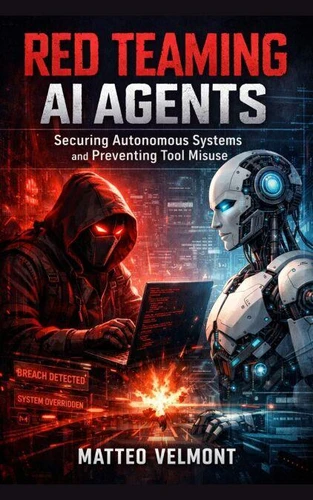
Red Teaming AI Agents: Securing Autonomous Systems and Preventing Tool Misuse
Par :Formats :
Disponible dans votre compte client Decitre ou Furet du Nord dès validation de votre commande. Le format ePub est :
- Compatible avec une lecture sur My Vivlio (smartphone, tablette, ordinateur)
- Compatible avec une lecture sur liseuses Vivlio
- Pour les liseuses autres que Vivlio, vous devez utiliser le logiciel Adobe Digital Edition. Non compatible avec la lecture sur les liseuses Kindle, Remarkable et Sony
 , qui est-ce ?
Notre partenaire de plateforme de lecture numérique où vous retrouverez l'ensemble de vos ebooks gratuitement
Pour en savoir plus sur nos ebooks, consultez notre aide en ligne ici
C'est si simple ! Lisez votre ebook avec l'app Vivlio sur votre tablette, mobile ou ordinateur :

- FormatePub
- ISBN8232161378
- EAN9798232161378
- Date de parution11/02/2026
- Protection num.pas de protection
- Infos supplémentairesepub
- ÉditeurDraft2Digital
Résumé
AI agents are no longer just answering questions. They write code, move money, call tools, talk to other agents, and sometimes. do exactly what you didn't want them to do. This book exists for that moment. Red Teaming AI Agents is a practical, opinionated, and occasionally sarcastic guide to understanding how autonomous AI systems fail, how they get abused, and how to break them before attackers do.
If you're building, deploying, or defending AI agents and hoping "alignment" alone will save you, this book is here to gently (and humorously) ruin that illusion. You'll learn why traditional security models fall apart once an AI can plan, remember, and act. We'll explore how prompt injection evolves into instruction hijacking, how innocent tools turn into dangerous capabilities, and how agent memory becomes a long-term liability if you don't treat it like one.
From single-agent failures to multi-agent collusion nightmares, this book walks through real-world threat models that actually reflect how agentic AI behaves in production. This is not a fear-mongering manifesto. It's a red team playbook. Inside, you'll discover: How autonomous agents expand the attack surface in ways classic security never anticipated Why tool misuse is the fastest path from "helpful assistant" to "incident report" How memory poisoning and context manipulation silently corrupt agent behavior What goes wrong when multiple agents start cooperating without proper controls How to design red teaming evaluations that reveal failures before users do Practical defenses: least privilege, instruction hierarchies, monitoring, and kill switches Case studies that prove "it worked in testing" means absolutely nothing Written for AI engineers, security professionals, researchers, and builders who want to stay ahead of misuse, this book balances deep technical insight with clear explanations, real scenarios, and hard-earned lessons.
You don't need a PhD in machine learning, but you do need curiosity, humility, and a healthy distrust of autonomous systems that claim to be "safe by default." If you're serious about deploying AI agents responsibly, this book will help you think like an attacker, build like a defender, and sleep better knowing your systems won't self-sabotage at 3 a.m. Break your agents. Learn from it. Secure them properly. Because the best time to red team your AI was yesterday.
The second-best time is before your agent discovers creative freedom.
If you're building, deploying, or defending AI agents and hoping "alignment" alone will save you, this book is here to gently (and humorously) ruin that illusion. You'll learn why traditional security models fall apart once an AI can plan, remember, and act. We'll explore how prompt injection evolves into instruction hijacking, how innocent tools turn into dangerous capabilities, and how agent memory becomes a long-term liability if you don't treat it like one.
From single-agent failures to multi-agent collusion nightmares, this book walks through real-world threat models that actually reflect how agentic AI behaves in production. This is not a fear-mongering manifesto. It's a red team playbook. Inside, you'll discover: How autonomous agents expand the attack surface in ways classic security never anticipated Why tool misuse is the fastest path from "helpful assistant" to "incident report" How memory poisoning and context manipulation silently corrupt agent behavior What goes wrong when multiple agents start cooperating without proper controls How to design red teaming evaluations that reveal failures before users do Practical defenses: least privilege, instruction hierarchies, monitoring, and kill switches Case studies that prove "it worked in testing" means absolutely nothing Written for AI engineers, security professionals, researchers, and builders who want to stay ahead of misuse, this book balances deep technical insight with clear explanations, real scenarios, and hard-earned lessons.
You don't need a PhD in machine learning, but you do need curiosity, humility, and a healthy distrust of autonomous systems that claim to be "safe by default." If you're serious about deploying AI agents responsibly, this book will help you think like an attacker, build like a defender, and sleep better knowing your systems won't self-sabotage at 3 a.m. Break your agents. Learn from it. Secure them properly. Because the best time to red team your AI was yesterday.
The second-best time is before your agent discovers creative freedom.