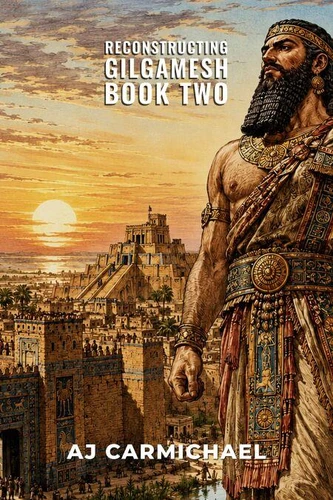
Reconstructing Gilgamesh, Book Two returns to the broken tablets, scattered fragments, and long history of scholarship behind the world's oldest surviving epic. For more than three thousand years, the story of Gilgamesh lay buried in clay, shattered across ruined libraries, temple archives, private collections, and museum drawers. What survives today is not one perfect ancient book, but a damaged body of tablets: Babylonian, Assyrian, Sumerian, Akkadian, partial, repeated, contradictory, and incomplete.
From these remains, generations of scholars have attempted to restore the king of Uruk, his wild companion Enkidu, the monster Humbaba, the death that breaks a man, and the desperate search for life beyond the grave. This book goes behind the finished story and into the hard work of reconstruction itself. It follows the manuscripts, the missing lines, the variant traditions, the scribal choices, and the modern decisions that shape every edition of Gilgamesh we read today.
It asks how an epic can be rebuilt from fragments, what must be restored, what must be left uncertain, and why the gaps matter as much as the surviving words. Grounded in seventeen years of translation, comparison, refinement, and textual study, *Reconstructing Gilgamesh, Book Two* is not a simple retelling. It is a study of survival: the survival of a king, a friendship, a civilization, and a literary monument that reached us only because broken clay refused to disappear.
This is Gilgamesh returned to the workshop of history - not as myth polished smooth, but as an ancient text recovered piece by piece from ruin.
Reconstructing Gilgamesh, Book Two returns to the broken tablets, scattered fragments, and long history of scholarship behind the world's oldest surviving epic. For more than three thousand years, the story of Gilgamesh lay buried in clay, shattered across ruined libraries, temple archives, private collections, and museum drawers. What survives today is not one perfect ancient book, but a damaged body of tablets: Babylonian, Assyrian, Sumerian, Akkadian, partial, repeated, contradictory, and incomplete.
From these remains, generations of scholars have attempted to restore the king of Uruk, his wild companion Enkidu, the monster Humbaba, the death that breaks a man, and the desperate search for life beyond the grave. This book goes behind the finished story and into the hard work of reconstruction itself. It follows the manuscripts, the missing lines, the variant traditions, the scribal choices, and the modern decisions that shape every edition of Gilgamesh we read today.
It asks how an epic can be rebuilt from fragments, what must be restored, what must be left uncertain, and why the gaps matter as much as the surviving words. Grounded in seventeen years of translation, comparison, refinement, and textual study, *Reconstructing Gilgamesh, Book Two* is not a simple retelling. It is a study of survival: the survival of a king, a friendship, a civilization, and a literary monument that reached us only because broken clay refused to disappear.
This is Gilgamesh returned to the workshop of history - not as myth polished smooth, but as an ancient text recovered piece by piece from ruin.