
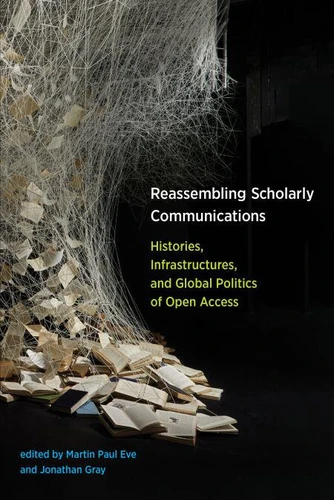
Reassembling Scholarly Communications. Histories, Infrastructures, and Global Politics of Open Access
Par : ,Formats :
Disponible dans votre compte client Decitre ou Furet du Nord dès validation de votre commande. Le format ePub protégé est :
- Compatible avec une lecture sur My Vivlio (smartphone, tablette, ordinateur)
- Compatible avec une lecture sur liseuses Vivlio
- Pour les liseuses autres que Vivlio, vous devez utiliser le logiciel Adobe Digital Edition. Non compatible avec la lecture sur les liseuses Kindle, Remarkable et Sony
- Non compatible avec un achat hors France métropolitaine
 , qui est-ce ?
Notre partenaire de plateforme de lecture numérique où vous retrouverez l'ensemble de vos ebooks gratuitement
Pour en savoir plus sur nos ebooks, consultez notre aide en ligne ici
C'est si simple ! Lisez votre ebook avec l'app Vivlio sur votre tablette, mobile ou ordinateur :

- Nombre de pages472
- FormatePub
- ISBN978-0-262-36286-3
- EAN9780262362863
- Date de parution20/10/2020
- Protection num.Adobe DRM
- Taille8 Mo
- Infos supplémentairesepub
- ÉditeurThe MIT Press
Résumé
A range of perspectives on the complex political, philosophical, and pragmatic implications of opening research and scholarship through digital technologies. The Open Access Movement proposes to remove price and permission barriers for accessing peer-reviewed research work--to use the power of the internet to duplicate material at an infinitesimal cost-per-copy. In this volume, contributors show that open access does not exist in a technological vacuum; there are complex political, philosophical, and pragmatic implications for opening research through digital technologies.
The contributors examine open access across spans of colonial legacies, knowledge frameworks, publics and politics, archives and digital preservation, infrastructures and platforms, and global communities.
The contributors examine open access across spans of colonial legacies, knowledge frameworks, publics and politics, archives and digital preservation, infrastructures and platforms, and global communities.